Vascular Laser Treatment in Des Moines, WA
Targeted laser treatment to eliminate visible spider veins, broken capillaries, cherry angiomas, and vascular lesions. Allen Medical Aesthetics in Des Moines, WA provides clinically supervised vascular laser treatment.
- Treatment Time
- 15-30 minutes
- Downtime
- Minimal
- Results In
- 2-4 weeks
- Lasts
- Long-term
- Sessions
- 1-3
- Best For
- Veins & redness
What Is Vascular Laser Treatment?
Vascular laser treatment is a targeted procedure that uses selective photothermolysis to heat and collapse unwanted blood vessels. The laser emits a specific wavelength of light that is absorbed by hemoglobin in the targeted blood vessel. This selective absorption heats the vessel wall, causing it to collapse. The body then naturally reabsorbs the treated vessel over the following weeks, and the visible vein, capillary, or lesion fades from view.
At Allen Medical Aesthetics in Des Moines, WA, vascular laser treatments are performed by our licensed providers. We treat a range of vascular concerns including spider veins on the face and body, broken capillaries around the nose and cheeks, rosacea-related redness and visible blood vessels, and cherry angiomas.
If you have been searching for laser vein removal near me or spider vein treatment, we encourage you to schedule a consultation. We also offer IPL photofacial treatments, and your provider will determine which approach is most appropriate for your specific vascular concerns.
How Vascular Laser Treatment Works
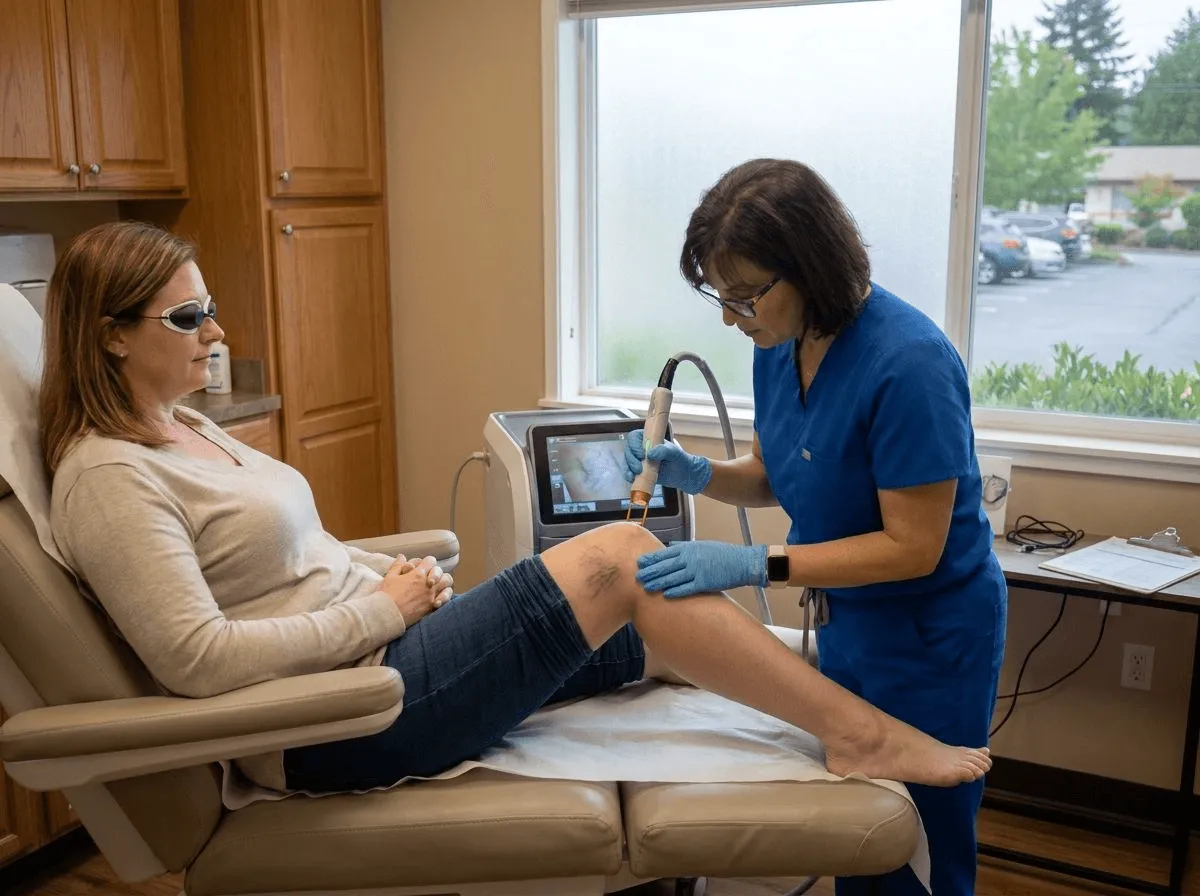
The laser emits a wavelength of light specifically absorbed by hemoglobin in blood vessels. This selective absorption converts to heat, collapsing the vessel wall. The body then reabsorbs the treated vessel naturally over the following weeks.
Vascular lesions like spider veins and broken capillaries respond well to targeted laser energy. The laser selectively heats the blood vessel, causing it to collapse and be reabsorbed by the body. For most patients, the improvement is visible within a few weeks.
Consultation and assessment
Your provider evaluates your vascular concerns, identifies the type and depth of the vessels involved, and determines whether vascular laser or IPL is the more appropriate treatment. We discuss expected outcomes, session count, and any pre-treatment precautions.
Pre-treatment preparation
Avoid blood thinners (if medically appropriate), alcohol, and direct sun exposure for 48 hours before your appointment. Arrive with clean skin, free of makeup and sunscreen on the treatment area.
Laser treatment
The laser delivers brief pulses of energy to the targeted vessels. Most patients describe a snapping or pinching sensation with each pulse. Cooling is applied during the procedure to manage discomfort. Sessions typically take 15 to 45 minutes depending on the treatment area and number of vessels.
Post-treatment care
Treated vessels may appear darker immediately after treatment. This is the expected response. Mild redness or swelling resolves within one to three days. Avoid intense exercise, hot showers, and direct sun exposure for 48 hours. Sun protection is critical during the healing period.
Ready to see if vascular laser treatment is right for you?
$50 consultation fee, applied toward your first treatment. No pressure, no obligation.
Conditions Treated and Ideal Candidates
Vascular laser treatment is effective for a range of visible vascular conditions. During your consultation, we evaluate the type, size, and depth of your vascular concerns to determine the right treatment approach.
- Spider veins on the face and body
- Broken capillaries around the nose, cheeks, and chin
- Rosacea-related redness and visible blood vessels
- Cherry angiomas (small red spots)
- Port wine stains (vascular birthmarks)
- Other visible vascular lesions
Is This Treatment Right for You?
Sound like you? Let's talk about your goals.
Book a Consultation- Patients with visible spider veins, broken capillaries, or cherry angiomas who want non-surgical treatment
- Those with rosacea-related redness and visible facial vessels that have not responded to topical treatments alone
- Patients who prefer the precision of a single-wavelength vascular laser over broader IPL treatment
- Anyone with vascular concerns who wants clinically supervised care
- Patients willing to commit to one to three sessions for optimal clearance
Recovery and Results
Recovery after vascular laser treatment is minimal. Most patients experience mild redness and occasional swelling at the treatment site for one to three days. Treated vessels may appear darker initially before they begin to fade. This darkening is the expected response and means the treatment was effective.
You can return to most normal activities immediately after treatment. Avoid intense exercise, hot showers, saunas, and direct sun exposure for 48 hours. Sun protection is particularly important during the healing period, as UV exposure can stimulate new vessel formation and interfere with results.
Spider veins and broken capillaries typically fade over two to six weeks as the body reabsorbs the treated vessels. Most patients see significant improvement in one to three sessions spaced four to six weeks apart. Smaller vessels may resolve after a single treatment, while larger or deeper vessels may require additional sessions.
Treated vessels may appear darker. Mild redness around the treatment area. You can return to most normal activities.
Mild redness and occasional swelling resolve. Keep the area protected from sun exposure.
Treated vessels begin to fade as the body reabsorbs the collapsed vessel tissue. Improvement becomes progressively visible.
Full results from the session are apparent. Follow-up session can be scheduled if additional vessels need treatment.
Common Questions About Vascular Laser Treatment
What is the difference between vascular laser and IPL?
Vascular laser uses a single, precise wavelength to target individual blood vessels with focused energy. IPL uses broad-spectrum light to treat diffuse redness and pigmentation across a larger area simultaneously. For isolated spider veins, prominent capillaries, or cherry angiomas, vascular laser is often more effective due to its precision. For widespread redness or a combination of pigmentation and vascular concerns, IPL may be the better option. We offer both and recommend based on individual assessment.
What are my options for spider vein treatment?
For facial spider veins, vascular laser treatment is the standard of care. The laser targets the vein directly, causing it to collapse and fade over two to six weeks. For smaller facial vessels and broken capillaries, a single session often produces significant improvement. For larger veins on the legs, additional options like sclerotherapy may be discussed during your consultation. We evaluate the size, location, and depth of the veins to recommend the right approach.
What is recovery like after vascular laser treatment?
Most patients experience mild redness and occasional swelling for one to three days after treatment. Treated vessels may appear darker before they begin to fade. You can return to most normal activities immediately. Avoid intense exercise, hot showers, and direct sun exposure for 48 hours. Full results develop over two to six weeks as the body reabsorbs the treated vessels.
How many vascular laser sessions do I need?
Most patients see significant improvement in one to three sessions spaced four to six weeks apart. Smaller spider veins and broken capillaries may resolve after a single treatment. Larger or deeper vessels and conditions like rosacea-related redness may require additional sessions. Your provider outlines a treatment plan during your consultation based on the extent and type of your vascular concerns.
Is vascular laser treatment painful?
Most patients describe the sensation as a brief snap or pinch with each laser pulse. We use cooling during the procedure to manage discomfort and protect the surrounding skin. The treatment is well-tolerated by the majority of patients, and sessions are typically short, lasting 15 to 45 minutes depending on the treatment area. No anesthesia is required.
How many vascular laser sessions does it take to remove spider veins?
Most facial spider veins and broken capillaries respond well in one to three sessions spaced four to six weeks apart. Leg spider veins may require two to four sessions depending on the size and density of the vessels. Small, isolated vessels often clear in a single treatment. Your provider will assess the size, location, and depth of your vascular concerns and give you a realistic session estimate.
Do spider veins come back after laser treatment?
The specific vessels that are treated and destroyed will not return. However, new spider veins can develop over time due to genetics, aging, sun exposure, and hormonal changes. Maintenance treatments once or twice a year can address any new vessels that appear. Wearing daily sun protection and maintaining a healthy lifestyle can help slow the development of new vascular lesions.
Is vascular laser or sclerotherapy better for spider veins?
Both are effective, but they work differently. Vascular laser targets vessels from outside the skin using focused light energy and is ideal for small facial veins, broken capillaries, and rosacea. Sclerotherapy involves injecting a solution directly into leg veins. For facial veins and small superficial vessels, laser is typically preferred. For larger leg veins, sclerotherapy may be more effective. Your provider will recommend the best approach based on the location and size of your veins.
Explore Similar Services
IPL Photofacial
Intense pulsed light therapy for sun damage, redness, rosacea, and uneven skin tone.
Explore IPL PhotofacialLaser & SkinChemical Peels
Medical-grade chemical peels for skin renewal, pigmentation correction, and texture improvement.
Explore Chemical PeelsLaser & SkinDiamondGlow Facial
Medical-grade facial combining exfoliation, extraction, and serum infusion for immediate glow.
Explore DiamondGlow FacialRelated Articles
Laser Treatment for Spider Veins: What to Know
Spider veins are one of the most common cosmetic concerns we see at Allen Medical Aesthetics. These small, visible clusters of red, blue, or purple veins can ap...
Read article Laser and SkinLaser Treatment for Rosacea: Options and Results
Rosacea is a chronic inflammatory skin condition that affects an estimated 16 million Americans. It causes persistent redness, visible blood vessels, and in som...
Read article Laser and SkinIPL for Rosacea: Does It Work? What to Know
Rosacea affects roughly 16 million Americans, causing persistent facial redness, visible blood vessels, flushing, and (in some cases) acne-like breakouts. If yo...
Read articleAllen Medical Aesthetics serves patients from across the greater Seattle area. Visit our Des Moines, WA clinic for vascular laser treatment.
Schedule Your Vascular Laser Consultation
Contact Allen Medical Aesthetics in Des Moines, WA to schedule a vascular laser consultation. Our providers oversee all vascular treatments. We will evaluate your concerns, determine whether vascular laser or IPL is the best approach, and build a treatment plan. Call (206) 414-9979 or book online. We serve patients from Des Moines, Federal Way, Kent, Burien, Seattle, and throughout South King County.
- Board-certified providers
- FDA-approved products only
- $50 consultation fee applied to treatment
- Transparent, honest pricing
- Individualized treatment plans
Request a Consultation
We will respond within one business day.
Thank you for reaching out.
We will respond within one business day. You can also call us at (206) 414-9979.
Something went wrong.
Please try again or call us directly at (206) 414-9979.