
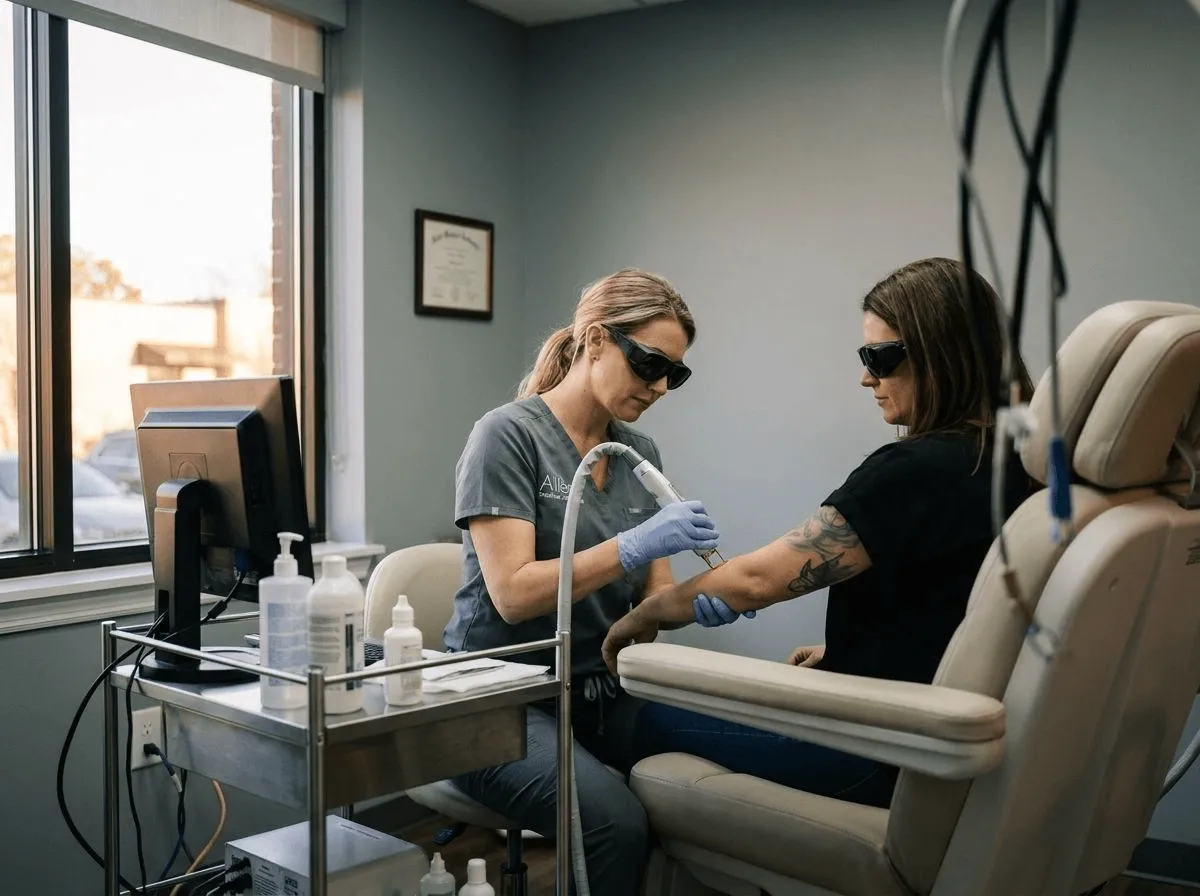
Whether you have a tattoo you regret, one that no longer fits your lifestyle, or ink that you want to lighten before a cover-up, laser tattoo removal is the safest and most effective way to break down unwanted ink. Modern laser technology has transformed what was once a slow, painful, and unpredictable process into a well-understood treatment with reliable results.
At Allen Medical Aesthetics, we use PICO laser technology for tattoo removal. PICO lasers represent the latest generation of tattoo removal devices, delivering ultra-short pulses of energy that shatter ink particles more efficiently than older nanosecond lasers. This guide covers everything you need to know about how the process works, what to expect during treatment, and how to set realistic expectations for your results.
Laser tattoo removal uses concentrated light energy to break tattoo ink into tiny particles that your immune system can naturally flush away. PICO laser technology delivers energy in trillionths-of-a-second pulses, shattering ink more effectively than older lasers. Most tattoos require 5 to 12 sessions spaced 6 to 8 weeks apart, with black ink responding fastest and certain colors (green, light blue, white) being more challenging.
PICO laser technology is the current gold standard for tattoo removal, offering faster ink clearance, fewer sessions, and reduced risk of scarring compared to older Q-switched nanosecond lasers.
How Laser Tattoo Removal Works
Tattoo ink sits in the dermis, the second layer of your skin, where it is too deep for your body to remove on its own. The ink particles are simply too large for your immune cells (macrophages) to break down and carry away. That permanence is exactly what makes tattoos last, and it is also what makes removal a gradual process.
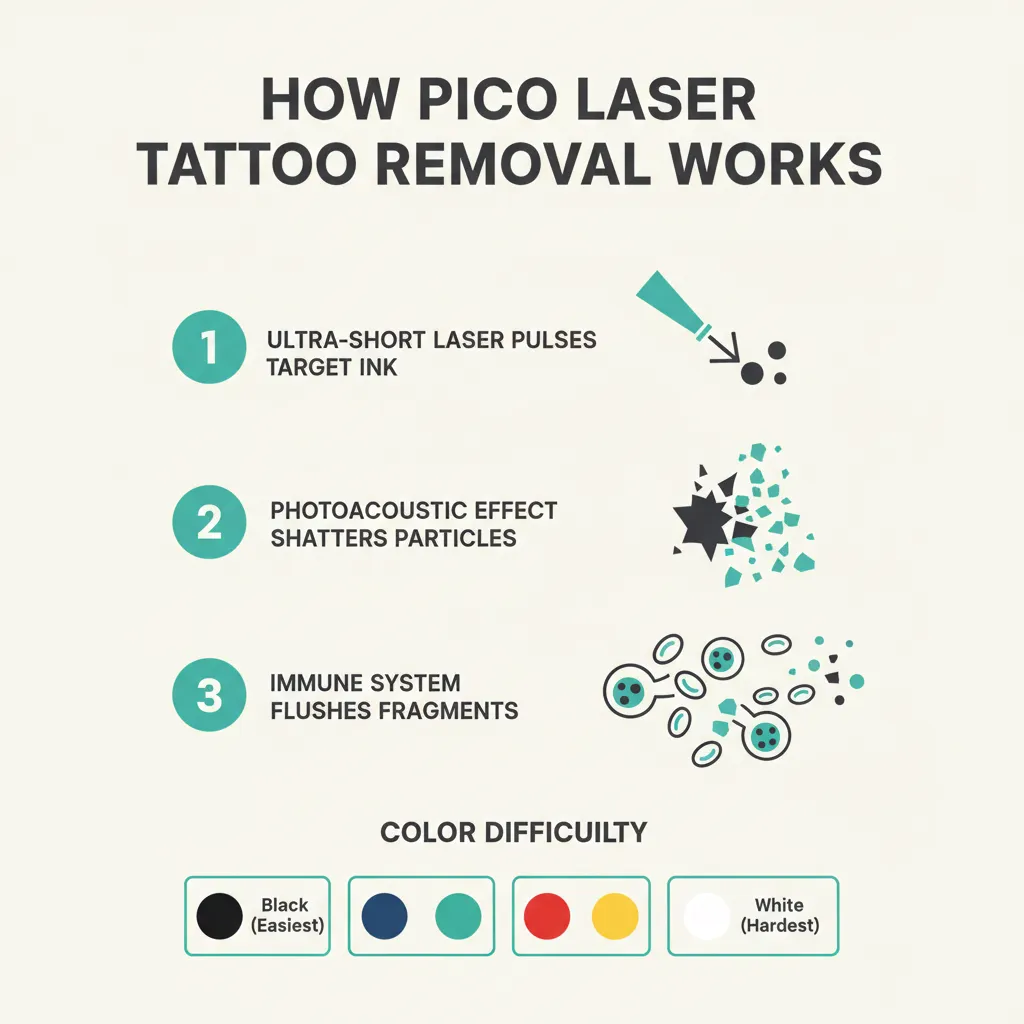
Laser tattoo removal works by delivering extremely short, powerful pulses of light energy at specific wavelengths that are absorbed by the tattoo pigment. When the ink absorbs this energy, it heats up rapidly and fractures into smaller fragments. These smaller particles are then small enough for your lymphatic system and immune cells to recognize, engulf, and transport to the liver for elimination.
Each treatment session breaks down a portion of the remaining ink. Between sessions, your body works continuously to flush the fragmented particles. This is why tattoos fade gradually over a series of treatments rather than disappearing after a single session.
Laser tattoo removal does not "erase" ink from the skin. It shatters ink particles into fragments small enough for your immune system to remove naturally. Your body does most of the work between sessions.
PICO Laser Technology: Why It Matters
The term "PICO" refers to picosecond, which is one trillionth of a second. PICO lasers deliver energy pulses in the picosecond range (typically 375 to 750 picoseconds), compared to older Q-switched lasers that operate in the nanosecond range (billionths of a second). That difference in pulse duration changes the fundamental mechanism of how ink is broken down.
Older nanosecond lasers rely primarily on a photothermal effect: the laser heats the ink until it fractures. While effective, this thermal energy also affects the surrounding skin tissue, which can increase the risk of scarring and textural changes. The longer pulse duration also produces larger ink fragments, meaning more sessions are often needed for complete clearance.
PICO lasers work through a photoacoustic (or photomechanical) effect. The ultra-short pulse delivers energy so quickly that it creates a shockwave that mechanically shatters the ink particles rather than simply heating them. This produces much finer ink fragments, which are easier for the immune system to clear. The reduced thermal impact on surrounding tissue also means less risk of scarring, less discomfort, and faster healing between sessions.
At Allen Medical Aesthetics, our PICO laser system includes multiple wavelengths (1064 nm, 532 nm, and additional wavelengths for specialty colors) that allow us to target a wide range of ink colors effectively. The combination of picosecond pulse speed and wavelength versatility makes this the most advanced tattoo removal technology currently available.
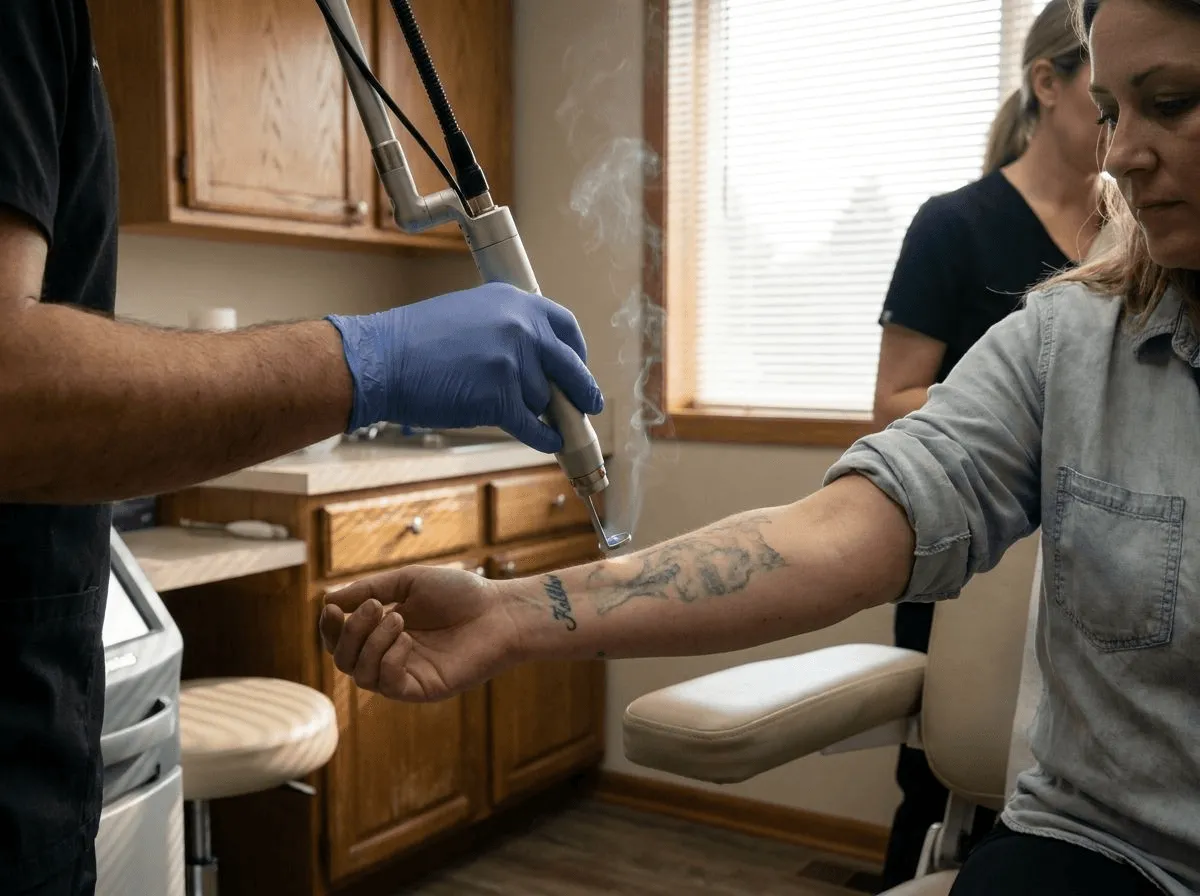

“PICO laser technology has been a real game-changer for tattoo removal. The picosecond pulses shatter ink into much finer particles than older lasers could achieve, which means the body clears them faster and we typically see better fading with fewer sessions. It has also made the process more comfortable for patients, which I really appreciate.”
Sophie Wittman, LME, MA-P Laser & Skin Specialist
What Happens During a Tattoo Removal Session
Understanding the treatment process helps reduce anxiety and allows you to prepare properly. A typical laser tattoo removal session at Allen Medical Aesthetics follows a consistent protocol designed for safety, comfort, and optimal results.
Before treatment begins, we photograph the tattoo to document your starting point and track progress over time. The treatment area is cleaned and, depending on the size and location of the tattoo, a topical numbing cream may be applied 20 to 30 minutes before the procedure. For smaller tattoos, some patients opt to proceed without numbing.
During the treatment, the PICO laser handpiece is passed over the tattoo in a systematic pattern. Each pulse of light produces a snapping sensation, often compared to the snap of a rubber band against the skin. Most patients find the discomfort tolerable, especially with numbing. The entire treatment typically takes 5 to 30 minutes depending on the size of the tattoo.
Immediately after treatment, the skin will appear white or frosted, a phenomenon called "frosting" that occurs when gas bubbles form beneath the surface as ink particles are shattered. This frosting fades within 10 to 20 minutes. The area may also become red, swollen, and tender, similar to a mild burn. An ointment and bandage are applied, and you are given detailed aftercare instructions.
Questions about laser and skin?
Our providers offer consultations to discuss your options. The $50 fee is applied toward your first treatment.
Talk to a ProviderTattoo Colors and Removal Difficulty
Not all tattoo ink responds equally to laser treatment. The color of your ink is one of the most significant factors in determining how many sessions you will need and how completely the tattoo can be removed. Different pigments absorb different wavelengths of light, and some colors are inherently more resistant to laser energy.
| Ink Color | Difficulty Level | Wavelength Used | Notes |
|---|---|---|---|
| Black | Easiest | 1064 nm | Absorbs all laser wavelengths; most responsive to treatment. Typically requires the fewest sessions. |
| Dark Blue / Navy | Easy | 1064 nm | Responds similarly to black ink. Usually clears well within a standard treatment course. |
| Red | Moderate | 532 nm | Responds well to 532 nm wavelength. May require slightly more sessions than black ink. |
| Orange | Moderate | 532 nm | Similar response to red. The 532 nm wavelength targets warm-toned pigments effectively. |
| Purple | Moderate to Difficult | 1064 nm / 694 nm | Contains both red and blue pigments. May require a combination of wavelengths for full clearance. |
| Green | Difficult | 694 nm / 755 nm | One of the most stubborn colors. Requires specific wavelengths that older lasers often lack. |
| Light Blue / Turquoise | Difficult | 694 nm | Resistant to standard wavelengths. May not clear completely in all cases. |
| Yellow | Very Difficult | 532 nm | Reflects most laser wavelengths rather than absorbing them. Difficult to remove completely. |
| White | Very Difficult / Unpredictable | Varies | Can darken (oxidize) when treated with laser. Requires caution and test spots. |
White and flesh-toned inks can darken permanently when exposed to laser energy due to a chemical reaction called oxidation. If your tattoo contains white ink, let your provider know during the consultation so they can perform a test spot first.
Are You a Good Candidate for Laser Tattoo Removal?
Most healthy adults with unwanted tattoos are good candidates for laser tattoo removal. However, certain factors can affect your eligibility, the expected timeline, and the degree of clearance you can realistically achieve.
Ideal candidates are in good general health with a functioning immune system, have tattoos with predominantly dark ink (black, dark blue, dark green), have lighter skin tones (Fitzpatrick types I through III, though darker skin types can be treated with appropriate settings), do not have active skin conditions in the treatment area, and are not pregnant or breastfeeding.
Patients with darker skin tones (Fitzpatrick types IV through VI) can still undergo laser tattoo removal, but the risk of hypopigmentation or hyperpigmentation is higher. The 1064 nm wavelength used for black ink is generally safe for all skin types because it bypasses melanin absorption more effectively. However, the 532 nm wavelength (used for red and orange ink) carries more risk for darker skin. Your provider will adjust settings accordingly and may recommend a test spot.
Certain medical conditions may affect your candidacy. These include autoimmune disorders that impair wound healing, a history of keloid scarring, active infections or skin conditions at the tattoo site, recent use of photosensitizing medications, and immunosuppressive conditions or medications that may slow the clearing process.
Pain Level: What Does Tattoo Removal Feel Like?
Pain tolerance varies from person to person, and the location of the tattoo plays a significant role in discomfort levels. Areas with thinner skin or more nerve endings (ribs, feet, inner arms, spine) tend to be more sensitive than fleshier areas (upper arms, thighs, back).
Most patients describe the sensation of PICO laser treatment as a rapid series of sharp snaps, similar to being flicked with a rubber band or having hot grease spatter on the skin. The sensation is intense but brief; each pulse lasts only a fraction of a second, and most treatments are completed within 5 to 30 minutes.
At Allen Medical Aesthetics, we offer several comfort measures to make the process more manageable. Topical numbing cream can be applied 20 to 30 minutes before treatment to reduce surface-level sensation. A skin cooling device is used during treatment to minimize discomfort and protect the surrounding skin. For patients with low pain tolerance or large tattoos, we can discuss additional options.
Many patients report that the discomfort of removal is comparable to or slightly more intense than getting the tattoo in the first place. The key difference is that removal sessions are much shorter than tattoo sessions, so the discomfort is brief.
The Consultation Process
A thorough consultation is the foundation of a successful tattoo removal plan. During your consultation at Allen Medical Aesthetics, your provider will evaluate several factors specific to your tattoo and your body to create a realistic treatment plan.
Your provider will assess the tattoo itself, including its size, location, ink colors, ink density, age, and whether it was applied professionally or as an amateur tattoo. They will also evaluate your skin type (Fitzpatrick scale), medical history, and any medications you are currently taking.
Based on this assessment, your provider will give you an estimated range for the number of sessions needed, explain the expected timeline for fading, discuss any limitations based on ink color or skin type, outline the costs and financing options, and answer any questions you have about the process.
We also use the consultation to set realistic expectations. While most tattoos can be significantly faded or fully removed, 100% clearance cannot be guaranteed for every tattoo. Factors like ink composition, depth of placement, and individual immune response all influence the final result. Being upfront about these variables helps you make an informed decision.
Bring photos of your tattoo when it was fresh if you have them. Seeing how the tattoo has already faded naturally over time gives your provider useful information about how your body processes ink and helps refine the session estimate.
What Results Can You Realistically Expect?
Setting realistic expectations is one of the most important aspects of the tattoo removal process. Modern PICO laser technology has significantly improved clearance rates compared to older lasers, but results still depend on multiple individual factors.
For many patients with black or dark ink tattoos and lighter skin tones, near-complete removal (90% to 95% clearance) is achievable within 6 to 10 sessions. Some tattoos clear even faster, particularly older tattoos that have already faded significantly, amateur tattoos with less ink density, and tattoos on areas with strong blood flow (torso, upper arms).
Other tattoos may be more resistant, requiring 10 to 15 or more sessions for maximum clearance. These include heavily saturated professional tattoos, multicolored tattoos (especially those containing green, yellow, or white ink), tattoos on extremities (hands, feet, ankles) where blood flow is lower, and cover-up tattoos with multiple layers of ink.
Even in cases where complete removal is not achievable, significant fading is almost always possible. Many patients pursue removal specifically to fade a tattoo enough for a successful cover-up by a tattoo artist, which typically requires only 3 to 5 sessions rather than full clearance.
Results are gradual. You will not see dramatic changes after a single session. The fading process is cumulative, with the most noticeable changes often appearing after the third or fourth treatment. Patience and consistency with your treatment schedule are essential for optimal results.
Frequently Asked Questions
How long does a laser tattoo removal session take?
Most sessions take 5 to 30 minutes of active treatment time, depending on the size of the tattoo. Including preparation and numbing, plan for a total appointment time of 30 to 60 minutes.
Can laser tattoo removal cause scarring?
Scarring is uncommon with PICO laser technology when treatments are performed by an experienced provider and proper aftercare is followed. The picosecond pulse duration reduces thermal damage to surrounding tissue, which lowers the risk of scarring compared to older nanosecond lasers. Most cases of scarring associated with tattoo removal are related to improper aftercare, such as picking at blisters or scabs.
Is laser tattoo removal safe for dark skin?
Yes, but it requires an experienced provider who understands how to adjust laser settings for darker skin types. The 1064 nm wavelength is generally safe for all skin types. The 532 nm wavelength carries a higher risk of pigmentation changes in darker skin. Your provider will assess your skin type during the consultation and adjust the treatment plan accordingly.
Can you remove a tattoo in one session?
No. Tattoo removal requires multiple sessions because only a portion of the ink can be safely treated at each appointment. Attempting to use too much energy in a single session increases the risk of burns, scarring, and hypopigmentation. Most tattoos require 5 to 12 sessions for significant clearance.
Does laser tattoo removal work on all tattoo colors?
Most colors can be significantly faded with modern multi-wavelength PICO lasers. Black, dark blue, and red respond best. Green, light blue, and yellow are more resistant but can still be treated. White and flesh-toned inks are the most unpredictable, as they may darken when exposed to laser energy.
What is the difference between PICO and Q-switched lasers for tattoo removal?
Both are effective, but PICO lasers deliver energy in shorter pulses (picoseconds vs nanoseconds), creating a photoacoustic shockwave that shatters ink into finer particles. This typically means faster clearance, fewer sessions, less thermal damage to surrounding skin, and lower risk of scarring compared to older Q-switched nanosecond lasers.
How much does laser tattoo removal cost?
The cost per session varies based on the size and complexity of the tattoo. Small tattoos may cost $150 to $300 per session, while larger or multicolored tattoos may range from $300 to $600 or more per session. A consultation will provide an accurate estimate based on your specific tattoo.
Related Articles
This article supports our Laser Tattoo Removal service page. Learn more about treatment options, candidacy, and what to expect.