

One of the most important questions patients ask before starting laser hair removal is how long the results will actually last. After investing time and money in a treatment series, you want to know whether you are looking at months, years, or a lifetime of smooth skin.
The short answer is that laser hair removal results are long-lasting and, for most patients, effectively permanent for the majority of treated hair. But the full picture involves understanding what "permanent reduction" means clinically, how your body continues to produce hair over time, and what kind of maintenance to expect in the years after treatment. This guide walks through all of it.
Laser hair removal provides permanent hair reduction, meaning most treated hair does not grow back. Results are long-lasting, with most patients maintaining significant hair reduction for years after completing their initial treatment series of 6 to 8 sessions. However, hormonal changes and dormant follicle activation can produce new growth over time, making periodic maintenance sessions (1 to 2 per year) beneficial for sustained results.
After completing a full treatment series, most patients enjoy years of dramatic hair reduction. The results are not 100% permanent, but with occasional maintenance, treated areas remain largely hair-free long-term.
What "Permanent Reduction" Actually Means
The FDA classifies laser hair removal as a method of "permanent hair reduction," which it defines as a long-term, stable reduction in the number of hairs that regrow after a treatment series. This is an important distinction from "permanent hair removal," which would mean that no hair ever grows back.
When a laser successfully targets and damages a hair follicle during the active growth phase (anagen), that specific follicle is permanently disabled. It will not produce hair again. The "reduction" part of the terminology acknowledges that the laser cannot reach every follicle during a treatment series. Some follicles are dormant during treatment and never receive laser energy. Others may be only partially damaged, allowing them to recover and eventually produce finer, lighter hair.
In practical terms, what most patients experience is a dramatic and lasting reduction in hair density. Areas that once required daily shaving may only produce a scattering of fine hairs months or years later. For many patients, this level of reduction makes the daily routine of hair removal essentially unnecessary.
How Many Sessions Are Needed for Lasting Results
The number of laser hair removal sessions needed depends on the treatment area, your hair type, and your biological hair growth cycle. The standard recommendation is 6 to 8 sessions spaced 4 to 8 weeks apart, but some patients may need more or fewer treatments.
The reason multiple sessions are required is rooted in the hair growth cycle. At any given time, only 20% to 30% of hair follicles are in the active anagen phase, which is the only phase when the laser can effectively disable the follicle. By spacing treatments 4 to 8 weeks apart, each session targets a different group of follicles as they cycle into anagen. Over the full treatment series, the majority of follicles are caught during their vulnerable phase.
| Body Area | Typical Sessions | Session Spacing | Typical Response After Full Series |
|---|---|---|---|
| Upper Lip | 6 to 8 | 4 to 6 weeks | Good |
| Underarms | 6 to 8 | 4 to 6 weeks | Excellent |
| Bikini / Brazilian | 6 to 10 | 4 to 6 weeks | Very good to excellent |
| Full Legs | 6 to 8 | 6 to 8 weeks | Very good |
| Back (Men) | 6 to 10 | 6 to 8 weeks | Good to very good |
| Chest (Men) | 6 to 8 | 6 to 8 weeks | Good |
Completing the full recommended treatment series is essential for optimal results. Stopping after 3 or 4 sessions means many follicles were never treated during their anagen phase, which will result in more noticeable regrowth.


“The number one thing I want patients to understand is why we space sessions the way we do. Your hair grows in cycles, and the laser can only disable follicles that are actively growing at the time of treatment. Sticking to your session schedule is honestly the most important thing you can do to get the best results.”
Morgan Selland, LME, LSO, MA Clinic Manager & Laser Safety Officer
What to Expect Year by Year After Treatment
Understanding the long-term timeline helps set realistic expectations. Here is what most patients experience in the months and years following their completed treatment series.
Months 1 to 3 After Final Session
In the first few months after completing your treatment series, you will notice the full effect of the cumulative treatments. Hair density in the treated area is dramatically reduced. Any remaining hair is usually finer, lighter, and slower growing than before treatment. Most patients stop needing to shave the treated area entirely or reduce shaving to once every few weeks.
Months 6 to 12
By six months to a year after your final session, results remain stable for most patients. You may notice occasional individual hairs appearing in the treated area. These are usually from follicles that were dormant during the treatment series and have since entered an active growth phase. They are typically sparse and fine. This is the point at which many patients schedule their first maintenance session to address any new growth.
Years 1 to 3
For most patients, years one through three represent a period of stable, lasting results. The follicles that were permanently disabled during treatment remain inactive. Some patients notice a gradual, very slow increase in fine hair growth, particularly in hormonally influenced areas. Annual maintenance sessions (1 to 2 per year) keep results looking clean and consistent. Many patients treating non-hormonal areas like the underarms and legs find they can go 12 to 18 months or longer between maintenance visits.
Years 3 to 5 and Beyond
In our experience, laser hair removal results remain durable over many years. Patients who completed a full treatment series and maintain periodic touch-ups continue to enjoy a significant, lasting hair reduction. The permanent nature of follicle damage means that the hair reduction from your original treatment series does not fade over time. Any new hair that appears is from previously untreated follicles, not from regrowth of treated ones.
Hormonal events (pregnancy, menopause, changes in medication, weight fluctuations) can trigger new follicle activation at any point. If significant new growth appears, a short series of 2 to 3 targeted sessions is usually sufficient to address it.
Questions about laser and skin?
Our providers offer consultations to discuss your options. The $50 fee is applied toward your first treatment.
Talk to a ProviderMaintenance Sessions: What to Expect
Maintenance sessions are brief, targeted treatments designed to address any new hair growth that appears after your initial treatment series is complete. They are a normal part of a comprehensive laser hair removal plan and are what keep your results looking their best year after year.
A typical maintenance session is faster and less expensive than your initial treatment sessions because there is far less hair to treat. Instead of covering a dense growth area, the laser targets scattered, fine hairs. Many patients complete a maintenance session in 10 to 15 minutes for areas like the underarms or bikini line.
How often you need maintenance depends on several factors. For non-hormonal areas (legs, arms, underarms), most patients need 1 to 2 sessions per year. Hormonally influenced areas (face, bikini) may benefit from 2 to 4 sessions per year, especially for patients with conditions like PCOS that stimulate ongoing hair growth. Some patients find they can extend the interval between maintenance sessions over time as fewer and fewer dormant follicles become active.
Think of maintenance sessions the way you think of dental cleanings: a brief, periodic visit that keeps your results in excellent condition with minimal effort. The time and cost of 1 to 2 maintenance sessions per year is negligible compared to daily shaving or monthly waxing.
Schedule your maintenance session as soon as you notice a few new hairs appearing rather than waiting for significant regrowth. Treating sparse, fine hairs is quicker, less uncomfortable, and more effective than letting them accumulate.
Factors That Affect How Long Results Last
While the follicle damage from laser treatment is permanent, several factors influence whether you experience significant new hair growth in the years after treatment.
Hormonal Changes
Hormones are the most significant factor in post-treatment hair growth. Events and conditions that alter hormone levels can activate dormant hair follicles that were never reached during your treatment series. Common hormonal triggers include pregnancy and postpartum changes, menopause and perimenopause, polycystic ovary syndrome (PCOS), thyroid disorders, starting or stopping hormonal birth control, and testosterone therapy.
Patients with known hormonal conditions should understand that laser hair removal will still dramatically reduce hair growth, but they may need more frequent maintenance sessions to manage new growth stimulated by ongoing hormonal activity.
Hair Color and Thickness
Patients with dark, coarse hair typically see the most dramatic and durable results because the laser can effectively target the high melanin concentration in each follicle. The follicle damage in these cases tends to be more complete, resulting in fewer partially damaged follicles that might recover over time.
Patients with finer or lighter hair may experience more gradual regrowth because lower melanin levels make it harder for the laser to deliver sufficient energy to fully disable each follicle. These patients may benefit from additional initial sessions and more frequent maintenance.
Treatment Area
Areas influenced by hormones (face, bikini, chest, back) tend to produce more new growth over time than non-hormonal areas (underarms, legs, arms). This is because hormonal fluctuations can activate follicles in these regions that were dormant during the original treatment series. Non-hormonal areas tend to produce the most stable, long-lasting results.
Completion of Initial Treatment Series
Patients who complete all recommended sessions achieve better, longer-lasting results than those who stop early. Each session in the series targets a new cohort of follicles in their anagen phase. Cutting the series short leaves a higher percentage of untreated follicles, which will continue to produce hair at their normal rate.
Laser Quality and Provider Expertise
The type of laser used, its settings, and the skill of the operator all affect the completeness of follicle damage. Medical-grade lasers operated by experienced providers deliver more consistent energy to more follicles, producing more thorough and longer-lasting results. Underpowered devices (including many at-home IPL units) may reduce hair temporarily without fully disabling follicles, leading to faster regrowth.
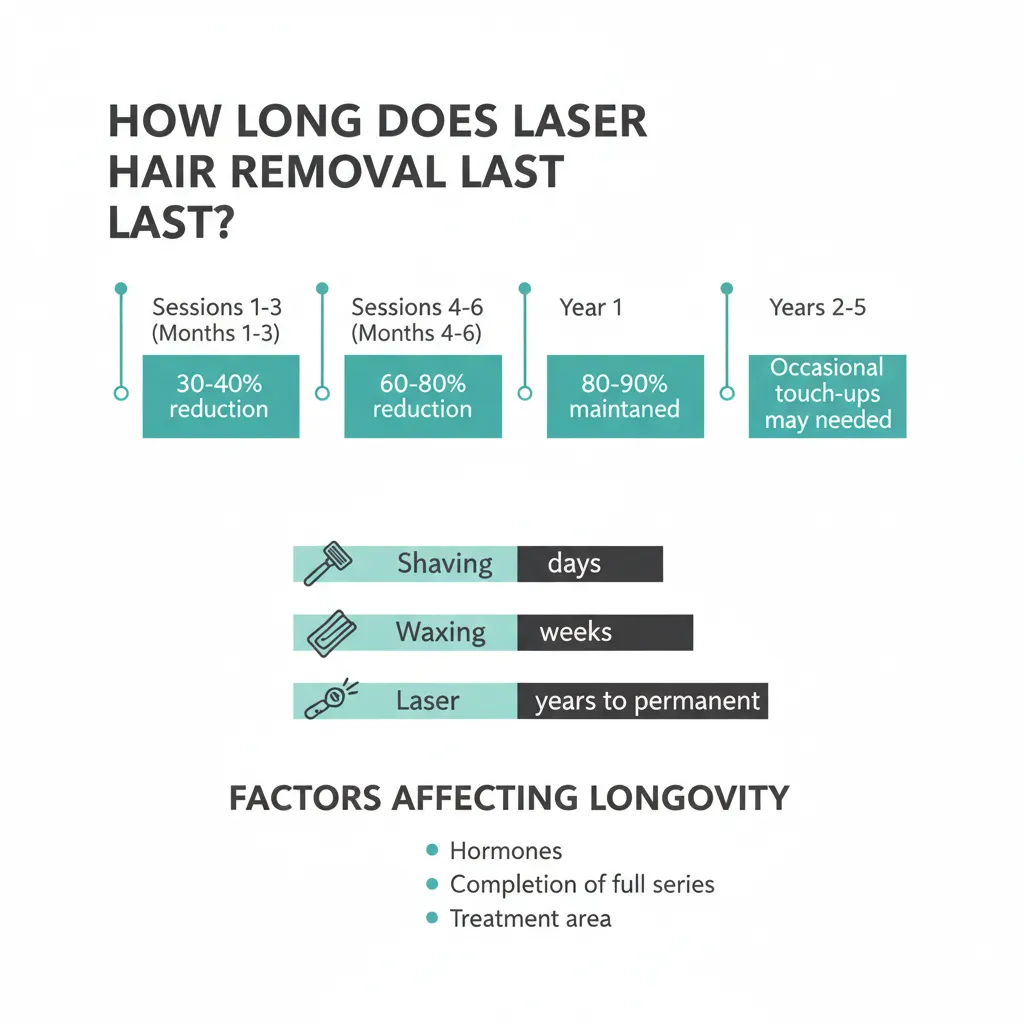
Laser Hair Removal vs Other Methods: Longevity Comparison
To put laser hair removal longevity in perspective, it helps to compare it to the duration of results from other hair removal methods.
| Method | How Long Results Last | Maintenance Required | Cumulative Time Investment (5 Years) |
|---|---|---|---|
| Laser Hair Removal | Years to permanent (significant, lasting reduction) | 1 to 2 sessions per year | 6 to 8 initial sessions + 5 to 10 maintenance sessions |
| Electrolysis | Permanent (individual follicles) | None once follicle is fully treated | 15 to 30+ sessions (one follicle at a time) |
| Waxing | 3 to 6 weeks | Every 3 to 6 weeks indefinitely | 40 to 85 sessions |
| Shaving | 1 to 3 days | Every 1 to 3 days indefinitely | 600 to 1,800 sessions |
| Depilatory Creams | 3 to 7 days | Every 3 to 7 days indefinitely | 250 to 600 applications |
| At-Home IPL Devices | Weeks to months (requires ongoing use) | Weekly initially, then monthly indefinitely | 100 to 250+ sessions |
Laser hair removal offers the best ratio of treatment time to result longevity of any hair removal method except electrolysis. After 6 to 8 initial sessions, you gain years of dramatic reduction with only occasional maintenance.
Can Laser Hair Removal Results Be Truly Permanent?
While no provider should promise 100% permanent hair removal, many patients do experience functionally permanent results in certain treatment areas. "Functionally permanent" means that hair reduction is so complete that no regular hair removal routine is needed.
This is most common in non-hormonal areas with coarse, dark hair, such as the underarms, where patients frequently report being completely hair-free for years after their treatment series. Even without maintenance sessions, many of these patients see little to no regrowth.
For other areas, particularly hormonally influenced zones, the term "permanent reduction with periodic maintenance" is the most accurate description. The key insight is that the follicles destroyed during treatment remain permanently disabled. Any new growth comes from a different source (previously dormant or newly activated follicles), not from regrowth of treated hair.
For a more detailed look at the science behind permanence, see our complete guide on whether laser hair removal is permanent.
Frequently Asked Questions
How long does laser hair removal last after 6 sessions?
After completing 6 sessions, most patients experience a significant hair reduction that lasts for years. Some patients may benefit from 2 additional sessions (8 total) for optimal results. The reduction is largely permanent, with maintenance sessions needed 1 to 2 times per year to address any new growth from previously dormant follicles.
Does laser hair removal last forever?
The individual follicles that are successfully damaged by the laser are permanently disabled and will not produce hair again. However, dormant follicles can become active over time, and hormonal changes can stimulate new growth. So while treated follicles are permanently affected, 100% total hair removal is not guaranteed. Periodic maintenance sessions keep results consistent.
How often do you need maintenance laser hair removal?
Most patients benefit from 1 to 2 maintenance sessions per year for non-hormonal areas (legs, arms, underarms). Hormonally influenced areas like the face and bikini may benefit from 2 to 4 sessions per year. Maintenance sessions are quick and less expensive than initial treatments because there is far less hair to address.
Why is my hair growing back after laser treatment?
Hair that appears after completing a treatment series typically comes from follicles that were dormant (in the telogen phase) during your treatments and have since become active. It can also result from hormonal changes activating new follicles. This hair responds well to additional laser treatment during maintenance sessions.
Does laser hair removal work better on some body areas?
Yes. Areas with coarse, dark hair and minimal hormonal influence (underarms, bikini, legs) tend to produce the most dramatic and long-lasting results. Hormonally influenced areas (face, chest, back) may require more sessions initially and more frequent maintenance, but still achieve significant, lasting reduction.
Can hormones cause hair to come back after laser?
Yes. Hormonal changes from pregnancy, menopause, PCOS, thyroid disorders, or medication changes can activate dormant follicles that were not treated during your original series. This new growth responds to laser treatment, and a short series of 2 to 3 maintenance sessions is usually enough to address it.
Is laser hair removal worth it long-term?
For most patients, laser hair removal provides significant long-term value. The upfront investment replaces years of ongoing costs (shaving supplies, waxing appointments) and eliminates the daily time commitment of other hair removal methods. Most patients describe it as one of the best aesthetic investments they have made.
Related Articles
This article supports our Laser Hair Removal service page. Learn more about treatment options, candidacy, and what to expect.