

One of the first questions every patient asks about laser tattoo removal is, "How many sessions will it take?" It is a fair question, and the honest answer is that it depends on several measurable factors specific to your tattoo and your body.
The typical range for most tattoos is 5 to 12 sessions, but that range is wide because no two tattoos are identical. A small, old, black-ink amateur tattoo on your upper arm might clear in 4 to 6 sessions. A large, multicolored professional piece on your ankle could take 12 to 15 or more. Understanding the factors that influence session count helps you set realistic expectations and commit to the process with confidence.
Most tattoos require 5 to 12 laser removal sessions spaced 6 to 8 weeks apart. The exact number depends on ink color, tattoo size, ink density, location on the body, age of the tattoo, your skin type, and your immune system health. Black ink on lighter skin responds fastest, while multicolored tattoos on extremities take the longest.
There is no single-session tattoo removal. The process is gradual by design, with each session breaking down a portion of ink that your immune system then clears over the following weeks.
The Typical Session Range: 5 to 12 Treatments
In our experience, most tattoos require between 5 and 12 sessions for significant clearance when treated with modern PICO laser technology. Older Q-switched nanosecond lasers often required even more sessions, sometimes 15 to 20 treatments for stubborn tattoos.
The wide range exists because tattoo removal is not a one-size-fits-all process. Two tattoos that look similar on the surface can respond very differently to laser treatment based on the type and depth of ink, how the tattoo was applied, and the patient's individual healing response.
At Allen Medical Aesthetics, we use PICO laser technology, which shatters ink particles into finer fragments than older lasers. This generally reduces the total number of sessions needed and produces more consistent fading between treatments. During your consultation, your provider will evaluate your specific tattoo and give you a personalized estimate.
The Kirby-Desai Scale: How Providers Estimate Sessions
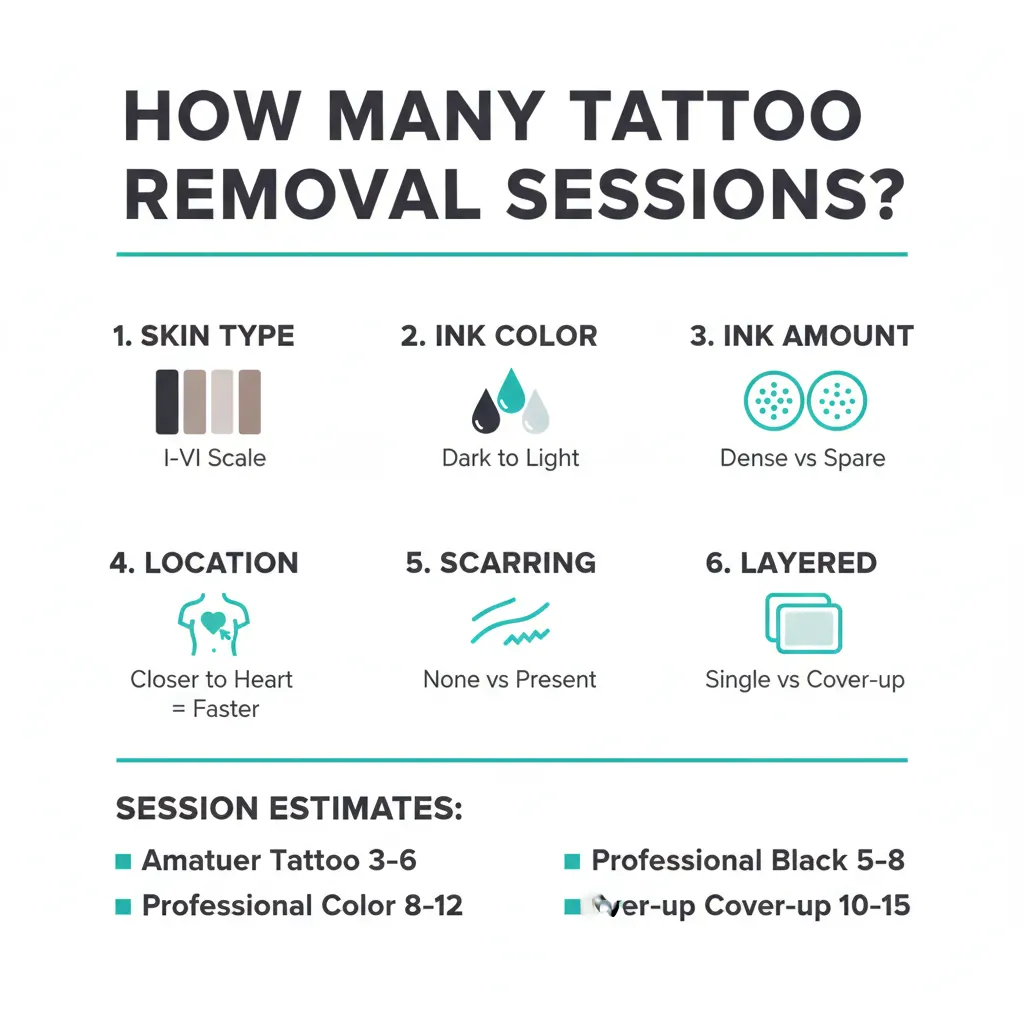
The Kirby-Desai scale is a validated clinical tool that providers use to estimate the number of laser sessions needed for tattoo removal. Developed by dermatologists, it assigns points based on six key factors. The total score correlates with the expected number of treatments.
Each factor is scored on a defined scale, and the points are added together to produce a total. Higher scores indicate more sessions will be needed. While no prediction model is perfect, the Kirby-Desai scale provides a structured, evidence-based starting point for setting expectations.
| Factor | What Is Assessed | Impact on Session Count |
|---|---|---|
| Skin Type (Fitzpatrick) | Your natural skin tone on the Fitzpatrick I to VI scale | Lighter skin (types I to II) allows more aggressive treatment settings, leading to fewer sessions. Darker skin requires lower energy to avoid pigmentation changes, increasing sessions. |
| Tattoo Location | Where on the body the tattoo is located | Areas with strong blood flow and lymphatic drainage (torso, upper arms) clear faster. Extremities (hands, feet, ankles) have less circulation and take longer. |
| Ink Color | The colors present in the tattoo | Black ink responds fastest. Red and orange respond well. Green, blue, yellow, and white are more resistant and add sessions. |
| Ink Density | How much ink is packed into the skin (saturation) | Heavily saturated tattoos with dense shading require more sessions than lightly applied tattoos. Cover-up tattoos with multiple ink layers score highest. |
| Scarring or Tissue Change | Whether the tattoo has existing scarring or raised texture | Pre-existing scarring can trap ink deeper in the dermis, making it harder for the laser to reach and for the immune system to clear. |
| Ink Layering | Whether the tattoo is a cover-up with multiple layers | Single-layer tattoos clear more predictably. Cover-ups with 2 or more layers of ink significantly increase the total number of sessions. |
Factors That Affect How Many Sessions You Need
While the Kirby-Desai scale provides a framework, it helps to understand each factor in more detail so you can assess your own tattoo and have a more informed conversation with your provider.
Ink Color
Black ink is the easiest to remove because it absorbs all wavelengths of laser light, giving the provider maximum flexibility with treatment parameters. Dark blue and dark green also respond reasonably well to the 1064 nm wavelength.
Red and orange inks are treated effectively with the 532 nm wavelength. They typically require a few more sessions than black but still respond well to PICO laser technology.
Green, light blue, yellow, and white inks are the most challenging. Green and light blue require specialty wavelengths (694 nm or 755 nm) that not all lasers offer. Yellow ink reflects most laser wavelengths rather than absorbing them, making it resistant to treatment. White ink can darken when hit with laser energy due to oxidation, requiring special handling.
Ink Density and Layering
A tattoo with heavy shading and solid fill contains significantly more ink per square centimeter than a fine-line tattoo or one with minimal shading. More ink means more material for the laser to break down, which translates directly to more sessions.
Cover-up tattoos present the greatest challenge because they contain multiple layers of ink applied at different times, often with different compositions. The laser must work through the top layer before it can access the ink underneath, and each layer adds sessions to the total treatment plan.
Tattoo Location on the Body
Your circulatory and lymphatic systems are responsible for carrying away the ink fragments that the laser creates. Areas of the body with strong blood flow and lymphatic drainage clear ink faster. The torso, chest, upper back, and upper arms tend to respond well because these areas have robust circulation.
Tattoos on the lower legs, ankles, feet, hands, and fingers take longer because blood flow and lymphatic drainage are weaker in the extremities. A tattoo on your forearm may take 2 to 3 more sessions to clear than the same tattoo would take on your upper back.
Age of the Tattoo
Older tattoos are generally easier to remove than newer ones. Over time, your immune system has already been slowly breaking down ink particles, causing the natural fading you may have noticed. This head start means the laser has less ink to target.
A tattoo that is 10 or more years old and has already faded significantly may need only 4 to 6 sessions. A fresh tattoo (less than 1 year old) with vibrant, saturated ink will likely need the full 8 to 12 session range or more.
Skin Type
Lighter skin tones (Fitzpatrick types I to III) allow providers to use higher laser energy settings without risking pigmentation changes. This means more ink can be broken down per session, reducing the total number of treatments.
Darker skin tones (Fitzpatrick types IV to VI) require lower energy settings to protect the melanin in the surrounding skin. While tattoo removal is absolutely possible for darker skin types, the reduced energy per session typically means more sessions are needed to achieve the same level of clearance.
Immune System Health
Because your immune system does the heavy lifting of clearing fragmented ink between sessions, your overall health directly affects the speed of your results. Patients who are generally healthy, well-hydrated, physically active, and non-smokers tend to see faster fading between treatments.
Smoking is particularly impactful. Smokers generally require more sessions on average than non-smokers for the same degree of tattoo clearance, because smoking constricts blood vessels and impairs immune function, both of which slow the ink-clearing process.
Questions about laser and skin?
Our providers offer consultations to discuss your options. The $50 fee is applied toward your first treatment.
Talk to a Provider
“Every tattoo tells a different story when it comes to removal. I look at the ink colors, how densely the artist packed the pigment, where the tattoo sits on the body, and how old it is. All of those factors together give me a realistic picture of what to expect. I would rather give an honest estimate upfront than have a patient feel surprised halfway through.”
Sophie Wittman, LME, MA-P Laser & Skin Specialist
Amateur vs Professional Tattoos
One of the most significant predictors of session count is whether the tattoo was applied professionally or by an amateur (including stick-and-poke, homemade machine tattoos, or prison tattoos).
Amateur tattoos are generally much easier to remove. The ink is typically placed at inconsistent depths, often shallower than professional tattoos. Less ink is used overall, the pigment density is lower, and only one or two colors (usually black) are involved. Amateur tattoos often respond well to just 3 to 5 sessions.
Professional tattoos are designed to last. Professional tattoo artists use machines that drive ink deep and consistently into the dermis, apply ink in dense, saturated layers, use high-quality pigments that are more stable and resistant to breakdown, and often incorporate multiple colors with different chemical compositions. These characteristics make professional tattoos more challenging to remove, typically requiring 6 to 12 sessions depending on the other factors discussed above.
If you are unsure whether your tattoo was done professionally or by an amateur, your provider can usually tell during the consultation based on ink depth, line consistency, and color saturation. This assessment helps refine the session estimate.
Why Sessions Are Spaced 6 to 8 Weeks Apart
Patience is a critical part of tattoo removal, and the spacing between sessions is not arbitrary. There are important biological and safety reasons for waiting 6 to 8 weeks between treatments.
After each laser session, your body needs time to complete the clearing process. Macrophages (immune cells) engulf the fragmented ink particles and transport them through the lymphatic system to the liver for elimination. This process takes weeks, not days. Treating again before the body has finished clearing the previous round of fragmented ink is counterproductive, as the laser would be targeting the same partially-cleared particles rather than penetrating to the next layer of intact ink.
The skin also needs time to heal between treatments. Each session causes controlled inflammation, and the skin must fully recover before it can safely tolerate another round of laser energy. Treating too frequently increases the risk of cumulative thermal damage, which can lead to scarring, texture changes, or prolonged healing.
Some providers space sessions even further apart (8 to 12 weeks) for certain tattoos, particularly those on extremities where healing and clearing take longer. While spacing sessions further apart means a longer overall timeline, it often produces better results per session because the body has more time to clear ink between treatments.
What Fading Looks Like Session by Session
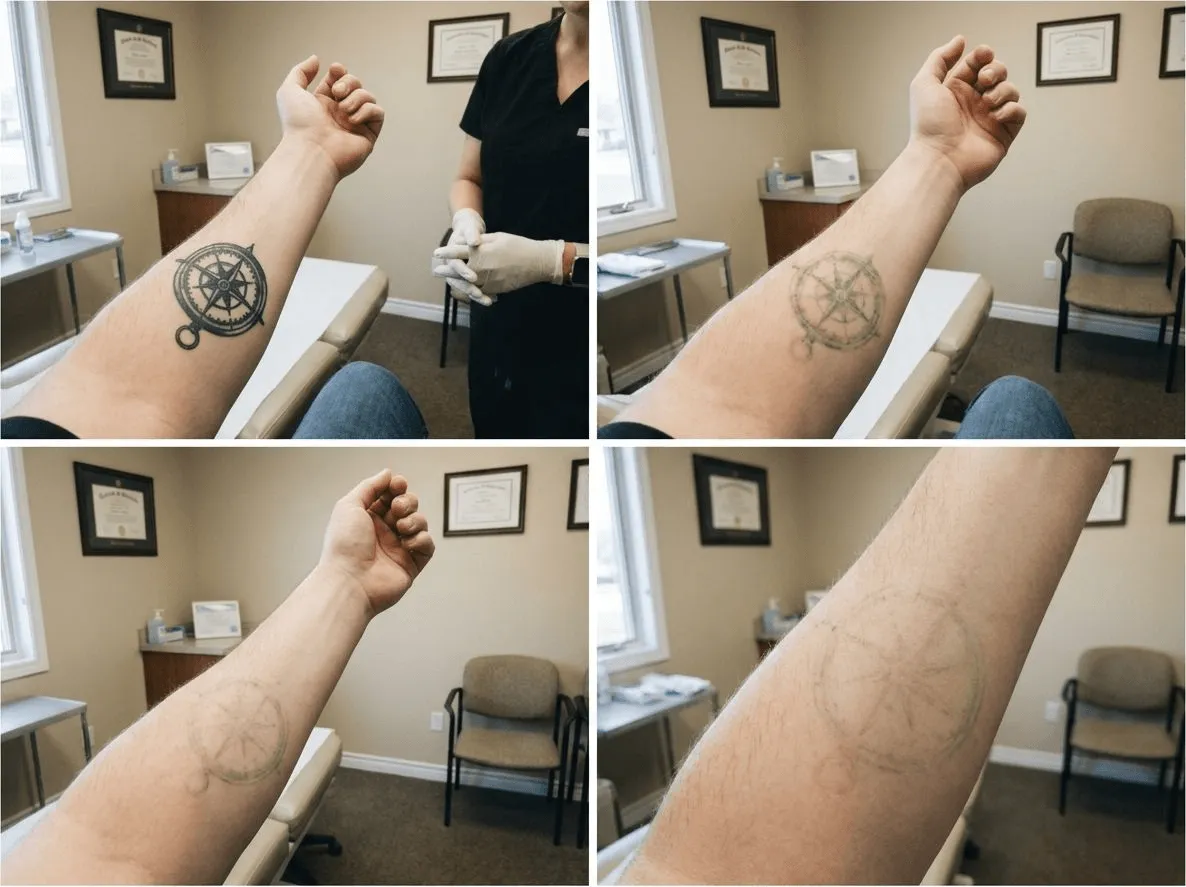
Understanding the typical fading progression helps you stay motivated throughout the process and recognize that even subtle changes represent real progress.
| Session Range | What You Can Expect to See |
|---|---|
| After sessions 1 to 2 | Subtle lightening may be noticeable, but the tattoo still looks largely intact. Fine details and edges may soften slightly. Some patients do not see obvious changes yet, which is normal. |
| After sessions 3 to 4 | Fading becomes more visible. The tattoo looks noticeably lighter, and areas with thinner ink coverage (shading, line work edges) show the most change. Color shifts may be apparent as certain pigments clear faster than others. |
| After sessions 5 to 7 | Significant fading is evident. Large portions of the tattoo may appear washed out or ghostly. Black ink areas may look gray. For many tattoos, this is the stage where cover-up work becomes viable if that is the goal. |
| After sessions 8 to 10 | Majority of ink is cleared for responsive tattoos. Remaining ink may appear as faint shadows or spotty remnants. Some stubborn areas (dense shading, resistant colors) may still hold visible pigment. |
| After sessions 10 to 12+ | Near-complete clearance for most tattoos. Any remaining ink is typically faint and difficult to see at normal viewing distance. Many patients are satisfied at this stage and choose to stop. |
Progress is not always linear. Some sessions produce dramatic fading while others show more subtle changes. This is normal and relates to the depth and distribution of remaining ink. Trust the process and attend follow-up appointments so your provider can track progress with photographs.
Can You Speed Up the Process?
While there is no shortcut that bypasses the biological clearing process, there are steps you can take to support your body and optimize results between sessions.
Stay well hydrated. Your lymphatic system, which transports ink fragments for elimination, functions best when you are properly hydrated. Drinking adequate water supports lymphatic drainage and overall immune function.
Exercise regularly. Physical activity increases blood flow and lymphatic circulation, both of which help your body clear ink fragments more efficiently. You should wait at least 48 hours after a treatment session before resuming vigorous exercise to allow initial healing.
Avoid smoking. As noted earlier, smoking significantly impairs the clearing process. If you smoke, quitting before and during your treatment course can meaningfully reduce the number of sessions you need.
Follow aftercare instructions carefully. Proper wound care between sessions ensures your skin heals cleanly and is ready for the next treatment on schedule. Complications like infection or poor healing can delay your next session and slow overall progress. Read our full aftercare guide for detailed recovery tips.
Protect the area from sun exposure. Tanned or sun-damaged skin cannot be treated as aggressively because the increased melanin in tanned skin competes with the ink for laser absorption. Keeping the treatment area covered and protected from UV ensures you can receive optimal treatment settings at every session.
Frequently Asked Questions
Can a tattoo be fully removed in 3 sessions?
Full removal in 3 sessions is unlikely for most tattoos. However, small amateur tattoos with black ink and light skin may achieve significant clearance in 3 to 5 sessions. Most professional tattoos require 6 to 12 sessions for substantial clearance.
Why does my tattoo look darker after a laser session?
This is normal and temporary. The frosting effect (white appearance immediately after treatment) fades within minutes, and some tattoos appear temporarily darker as the body mounts an inflammatory response. This darkening resolves within 1 to 2 weeks as the immune system begins clearing fragmented ink.
Do cover-up tattoos take longer to remove?
Yes. Cover-up tattoos contain multiple layers of ink applied at different times, often with different compositions. The laser must work through each layer, and the total ink volume is significantly higher. Cover-up tattoos typically require 2 to 4 additional sessions compared to single-layer tattoos.
Is there a maximum number of sessions I can have?
There is no strict medical maximum, but after 12 to 15 sessions, any remaining ink is likely resistant to further treatment. At that point, your provider will discuss whether additional sessions are likely to produce meaningful improvement or whether the current result represents the best achievable outcome.
Does the size of the tattoo affect how many sessions I need?
Size affects treatment time per session but does not directly determine the number of sessions. A small tattoo and a large tattoo with the same ink color, density, and location will require a similar number of sessions. However, larger tattoos may require that each session be broken into multiple appointments to limit the total area treated at once.
Can I remove just part of a tattoo?
Yes. Selective removal of specific elements within a tattoo is common. You can remove a name, a date, or a section of a larger design while leaving the rest intact. This approach is also useful for patients who want to modify a tattoo rather than remove it entirely.
Related Articles
This article supports our Laser Tattoo Removal service page. Learn more about treatment options, candidacy, and what to expect.