

If you are considering laser hair removal, you have probably wondered whether the results are truly permanent. It is the most common question patients ask before starting treatment, and the answer is more nuanced than a simple yes or no.
The terminology used in FDA clearances is "permanent hair reduction," not "permanent hair removal." That distinction matters. After a complete treatment series, most patients experience a significant, lasting reduction in hair growth in the treated area. The remaining hair is typically finer, lighter, and far less noticeable. Occasional maintenance sessions, usually once or twice a year, keep results consistent for the long term. This guide explains exactly why, how the science works, and what factors affect your individual results.
Laser hair removal provides permanent hair reduction. Most patients achieve a significant, lasting reduction in hair growth after 6 to 8 sessions. The treated hair follicles are permanently disabled, but dormant follicles and hormonal changes can produce new growth over time. Annual maintenance sessions keep results consistent.
Laser hair removal is the most effective long-term hair reduction method available. It is not 100% permanent, but it dramatically and durably reduces hair growth in treated areas.
How Laser Hair Removal Works
Laser hair removal uses a principle called selective photothermolysis. The laser emits a specific wavelength of light that is selectively absorbed by melanin, the pigment in the hair shaft. When the melanin absorbs this energy, it converts to heat, which travels down the hair shaft to the follicle. If enough thermal energy reaches the follicular stem cells and the dermal papilla (the structure that nourishes hair growth), these structures are permanently damaged and can no longer produce hair.
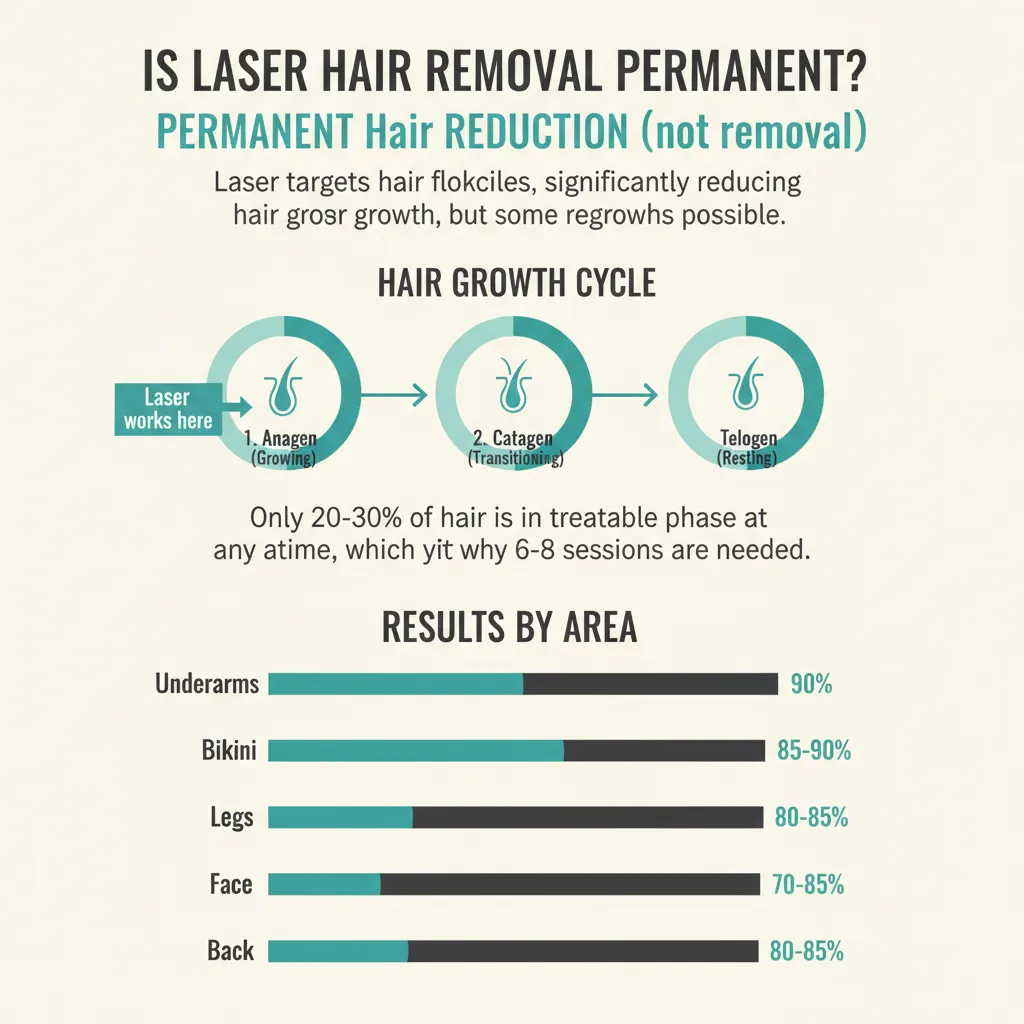
For this process to work effectively, the hair must be in its active growth phase, known as anagen. During anagen, the hair is physically connected to the follicle and contains the most melanin, creating the strongest pathway for energy transfer. Hair in the catagen (transitional) or telogen (resting) phase is either detaching from or already detached from the follicle, meaning the laser energy cannot effectively reach and damage the growth center.
This is the fundamental reason why multiple sessions are required. At any given time, only about 20% to 30% of hairs in a given area are in the anagen phase. Each treatment session disables the follicles that happen to be in active growth at that moment. Over 6 to 8 sessions spaced 4 to 8 weeks apart, the treatment catches the majority of follicles during their vulnerable anagen phase.
The precision of modern medical-grade lasers allows the treatment to target hair follicles while leaving surrounding skin unaffected. The laser's pulse duration is calibrated to the thermal relaxation time of the hair follicle, meaning the energy heats the follicle long enough to damage it but dissipates before it can harm the surrounding tissue. This is why laser hair removal, when performed with proper equipment and settings, has an excellent safety profile.
Permanent Reduction vs Permanent Removal: The FDA Distinction
The FDA clears laser hair removal devices for "permanent hair reduction," which it defines as "the long-term, stable reduction in the number of hairs regrowing after a treatment regime." This is an important distinction from "permanent hair removal," which would imply that no hair ever grows back.
The reason for this careful language is that the human body contains millions of hair follicles, and not all of them are active at the time of treatment. Dormant follicles that were not producing hair during your treatment series may become active later due to hormonal changes, aging, or other biological factors. When these previously dormant follicles activate, they produce new hair that was never treated by the laser.
Additionally, some treated follicles may not be completely destroyed but only damaged or miniaturized. These follicles can sometimes recover and produce hair again, though the regrowth is typically finer, lighter, and slower-growing than the original hair. This is why maintenance sessions are part of a long-term laser hair removal plan.
In practical terms, what most patients experience after a complete treatment series is a dramatic reduction in hair density and thickness. Areas that once required daily shaving or regular waxing may only need a quick touch-up once every few weeks, if that. For many patients, this level of reduction is functionally equivalent to permanent removal in their daily lives.
The FDA uses "permanent hair reduction" because not every follicle can be reached during treatment, and dormant follicles may activate later. In practice, most patients achieve a significant, lasting reduction with periodic maintenance.
Results by Body Area: Sessions Needed and Expected Reduction
Different body areas respond differently to laser hair removal based on the density of follicles, hair thickness, hormonal influence, and hair growth cycle length. The table below reflects what to generally expect based on our experience at Allen Medical Aesthetics, and your provider will set expectations specific to your hair and skin at consultation.
| Body Area | Sessions Needed | Session Interval | Typical Response | Notes |
|---|---|---|---|---|
| Upper Lip | 6 to 8 | 4 to 6 weeks | Good | Hormonal influence may require ongoing maintenance; finer hair may be less responsive |
| Chin and Jawline | 6 to 10 | 4 to 6 weeks | Good | Strongly influenced by hormones; may need more sessions for hormonal hair growth |
| Underarms | 6 to 8 | 4 to 6 weeks | Excellent | Excellent response area; coarse, dark hair responds very well to laser |
| Bikini Line | 6 to 8 | 4 to 6 weeks | Excellent | High response rate; coarse hair and contrast between hair and skin help |
| Full Brazilian | 6 to 10 | 4 to 6 weeks | Very good | Inner areas may need additional sessions; excellent long-term results |
| Full Legs | 6 to 8 | 6 to 8 weeks | Very good | Large treatment area; longer growth cycle means wider session spacing |
| Back (Men) | 6 to 10 | 6 to 8 weeks | Good to very good | Hormonally driven; may need ongoing maintenance; responds well to proper dosing |
| Chest (Men) | 6 to 8 | 6 to 8 weeks | Good | Good response with medical-grade lasers; hormonal influence similar to back |
| Arms | 6 to 8 | 6 to 8 weeks | Very good | Generally responds well; finer arm hair may require settings adjustment |
Areas with coarse, dark hair on lighter skin (such as underarms and bikini) tend to respond best and fastest. Facial hair in women may require more sessions due to hormonal factors that can stimulate new follicle growth.
Questions about laser and skin?
Our providers offer consultations to discuss your options. The $50 fee is applied toward your first treatment.
Talk to a ProviderWhy Multiple Sessions Are Required: Understanding Hair Growth Cycles
The need for multiple laser hair removal sessions is rooted in the biology of hair growth. Every hair follicle cycles through three distinct phases, and laser treatment is only effective during one of them.
The anagen phase is the active growth stage. During anagen, the hair is firmly anchored in the follicle and extends from the dermal papilla to the skin surface. The hair shaft is full of melanin, and the physical connection between hair and follicle creates the pathway the laser energy needs to reach and damage the growth center. Depending on the body area, anagen lasts anywhere from a few weeks (face) to several months (legs).
The catagen phase is a brief transitional period lasting about 2 to 3 weeks. The hair detaches from the dermal papilla and begins to shed. The follicle shrinks, and the connection between hair and growth center is severed. Laser treatment during this phase is ineffective because the energy cannot reach the growth structures.
The telogen phase is the resting period. The old hair has been shed (or is about to shed), and the follicle is dormant. No hair is present in the follicle, so there is no melanin target for the laser. Telogen can last 2 to 6 months depending on the body area. At any given time, 60% to 80% of body hair follicles are in telogen, which is why a single laser session can only treat a fraction of total follicles.
By spacing sessions 4 to 8 weeks apart over 6 to 8 treatments, the laser catches different groups of follicles as they cycle into anagen. This systematic approach is what produces the significant cumulative reduction most patients experience.
Factors That Affect How Permanent Your Results Are
While the science behind laser hair removal is consistent, individual results vary based on several biological and lifestyle factors. Understanding these variables helps set realistic expectations and explains why some patients see different outcomes than others.
Hair Color and Thickness
The ideal candidate for laser hair removal has dark, coarse hair. Darker hair contains more melanin, which absorbs more laser energy and transmits more heat to the follicle. Coarse hair shafts also contain more melanin per cross-section than fine hairs. Patients with thick, dark body hair tend to see the most dramatic and durable results.
Light brown and medium hair can still be treated effectively, but may require more sessions or higher energy settings. Very fine, light blonde, red, gray, or white hair contains little to no melanin and does not respond well to standard laser hair removal. For these hair types, electrolysis (which targets each follicle individually with an electric current) is typically the more effective option.
Skin Tone
Skin tone matters because the laser needs to differentiate between the melanin in the hair and the melanin in the skin. The greater the contrast between hair color and skin color, the more selectively the laser can target the hair follicle without affecting surrounding skin. Fair-skinned patients with dark hair have the most favorable contrast.
Advances in laser technology have made treatment safe and effective for a much wider range of skin tones than was possible a decade ago. Nd:YAG lasers (1064 nm wavelength) bypass epidermal melanin more effectively, making them the safest option for darker skin tones. At Allen Medical Aesthetics, we select the appropriate laser type and settings for each patient's individual skin tone to ensure both safety and effectiveness.
Hormonal Factors
Hormones are the single biggest factor in long-term regrowth after laser hair removal. Conditions that alter hormone levels, including polycystic ovary syndrome (PCOS), pregnancy, menopause, thyroid disorders, and certain medications, can stimulate dormant follicles to produce new hair growth in previously treated areas.
This is particularly relevant for facial hair in women and body hair in men. Patients with known hormonal conditions can still benefit significantly from laser hair removal, but should expect to need more initial sessions and more frequent maintenance treatments. Managing the underlying hormonal condition, when possible, also helps maintain laser hair removal results.
Treatment Area
As the results table above shows, different body areas respond differently. Hormonally sensitive areas (face, chest, back) tend to have more variable results and may require ongoing maintenance. Non-hormonal areas (underarms, bikini, legs) tend to produce more stable, long-lasting reduction.
What Happens After Your Treatment Series Is Complete
Once you have completed your initial series of 6 to 8 sessions, you will notice a dramatic reduction in hair growth. Most patients find that their treated areas are significantly clearer, and any remaining hair is significantly finer and lighter than before treatment.
In the months following your final session, you may notice occasional stray hairs appearing. These are typically from follicles that were dormant during your treatment series and have since become active, or from follicles that were damaged but not completely destroyed. These hairs are usually sparse and fine.
Maintenance sessions are the key to preserving your results long-term. Most patients benefit from 1 to 2 maintenance sessions per year, depending on the area treated and their hormonal profile. These sessions are quick, since there is far less hair to treat, and they keep your results looking clean and consistent.
Some patients, particularly those treating non-hormonal areas like the underarms or bikini line, find that they can go years between maintenance sessions. Others, especially those with hormonal conditions or those treating facial hair, may benefit from more frequent touch-ups. Your provider will recommend a maintenance schedule tailored to your individual needs.
Do not skip your scheduled sessions during the initial treatment series. Consistent session spacing is critical for catching follicles during their anagen phase. Skipping or delaying sessions can reduce overall effectiveness and extend the number of treatments needed.

“I always set expectations clearly with my patients: laser hair removal gives you permanent hair reduction, not permanent hair removal. Most people see a significant, lasting reduction in hair after a full series, and any remaining growth is usually so fine they barely notice it. The occasional maintenance session keeps everything looking smooth.”
Morgan Selland, LME, LSO, MA Clinic Manager & Laser Safety Officer
Laser Types: Which Technology Works Best
Not all lasers are created equal when it comes to hair removal. The type of laser used significantly impacts both the effectiveness and safety of treatment, especially for different skin tones. Understanding the main laser types helps you evaluate the technology available at any clinic you consider.
Diode lasers (800 to 810 nm wavelength) are among the most commonly used for hair removal. They offer excellent penetration depth and can treat a wide range of skin tones effectively. Diode lasers are particularly good for treating larger body areas efficiently, as they have relatively fast treatment speeds and good coverage.
Alexandrite lasers (755 nm wavelength) are the fastest hair removal lasers and are considered the gold standard for fair to medium skin tones. They provide excellent melanin absorption, making them highly effective for dark hair. However, their shorter wavelength means they carry a higher risk of side effects on darker skin tones, so they are typically reserved for Fitzpatrick types I through III.
Nd:YAG lasers (1064 nm wavelength) have the longest wavelength of the common hair removal lasers. This longer wavelength bypasses epidermal melanin more effectively, making Nd:YAG the safest option for darker skin tones (Fitzpatrick types IV through VI). The trade-off is slightly less efficient melanin absorption, which may require more sessions or higher energy settings.
At Allen Medical Aesthetics, we use medical-grade laser technology selected for its proven effectiveness across a range of skin tones and hair types. During your consultation, we assess your skin type, hair characteristics, and treatment area to determine the optimal laser settings for your individual needs.
| Laser Type | Wavelength | Best Skin Types | Speed | Key Advantage |
|---|---|---|---|---|
| Alexandrite | 755 nm | I to III (fair) | Fastest | Highest melanin absorption; very efficient on fair skin |
| Diode | 800 to 810 nm | I to V (fair to medium-dark) | Fast | Versatile; good balance of depth and absorption |
| Nd:YAG | 1064 nm | III to VI (medium to dark) | Moderate | Safest for darker skin; deepest penetration |
| IPL (not a true laser) | 500 to 1200 nm (broad spectrum) | I to III (fair) | Varies | Lower cost; less effective than true lasers for hair removal |
Laser Hair Removal vs Other Methods: A Complete Comparison
To put laser hair removal in context, it helps to compare it directly against other hair removal methods. Each approach has its own trade-offs in terms of permanence, pain, cost, and convenience.
When you factor in the cumulative time and cost of temporary methods over years and decades, laser hair removal is often the most cost-effective long-term solution. Recurring waxing appointments add up considerably over 5 to 10 years, all while dealing with ingrown hairs, skin irritation, and the inconvenience of growing hair out between appointments. A laser hair removal series addresses the problem at its source. Ask your provider for a specific cost estimate at consultation.
The one exception is electrolysis, which is generally regarded as the only method capable of true permanent hair removal rather than reduction. Electrolysis treats one follicle at a time using an electric current, making it extremely precise but also extremely time-consuming for large areas. For patients with light, fine, or gray hair that does not respond to laser, electrolysis is the best permanent option. For patients with dark hair treating larger body areas, laser hair removal offers comparable long-term reduction with significantly less treatment time. For more on light-based treatments, see our IPL photofacial page.
| Method | Permanence | Pain Level | Relative Cost Over 5 Years | Sessions/Frequency | Best For |
|---|---|---|---|---|---|
| Laser Hair Removal | Permanent reduction | Mild to moderate (rubber band snap) | Moderate (initial series + maintenance) | 6 to 8 sessions then 1 to 2 per year | Long-term reduction for most body areas |
| Electrolysis | True permanent removal | Moderate to high | Higher | 15 to 30+ sessions (treats individual follicles) | Light, fine, or gray hair; small areas |
| Waxing | Temporary (3 to 6 weeks) | Moderate | Higher, recurring indefinitely | Every 3 to 6 weeks indefinitely | Patients who want immediate smooth skin without commitment |
| Shaving | Temporary (1 to 3 days) | None | Lower (razors, cream) | Daily to every few days indefinitely | Quick, painless maintenance; lowest barrier to entry |
| IPL (at-home devices) | Moderate, temporary reduction | Mild | Lower (device purchase) | Weekly initially, then monthly | Budget-conscious patients with fair skin and dark hair |
| Depilatory Creams | Temporary (3 to 7 days) | None (may cause irritation) | Lower, recurring indefinitely | Every 3 to 7 days indefinitely | Painless surface-level removal for small areas |
Over a 10-year period, laser hair removal typically costs less than waxing while providing permanent reduction. It is the most efficient long-term solution for patients with dark hair who want to stop the cycle of temporary removal methods.
Frequently Asked Questions
Is laser hair removal truly permanent?
Laser hair removal provides permanent hair reduction, which the FDA defines as long-term, stable reduction in hair regrowth after a treatment series. Most patients experience a significant, lasting reduction in hair growth. It is not classified as permanent removal because dormant follicles may activate later, and some damaged follicles can partially recover.
How many laser hair removal sessions do I need?
Most patients need 6 to 8 sessions spaced 4 to 8 weeks apart to achieve optimal results. The exact number depends on the treatment area, hair type, skin tone, and individual factors. Some patients see significant reduction after 4 sessions, while others may need up to 10.
Does laser hair removal work on blonde or red hair?
Laser hair removal works best on dark hair because the laser targets melanin (pigment) in the hair shaft. Very light blonde, red, gray, and white hair contains insufficient melanin for effective laser treatment. Electrolysis is typically the better option for these hair colors.
Will hair grow back after laser treatment?
Some hair regrowth is possible, though it is typically finer and lighter than the original hair. Regrowth usually comes from follicles that were dormant during treatment or from hormonally activated new follicles. Annual maintenance sessions address any regrowth and maintain your results.
Is laser hair removal safe for all skin tones?
Modern laser technology, particularly Nd:YAG lasers, has extended safe treatment across a wide range of skin tones, with wavelength and settings selected after a Fitzpatrick skin type assessment. The risk of side effects like hyperpigmentation still increases with darker skin, so choosing a provider with experience treating diverse skin tones and access to appropriate laser technology is essential.
Does laser hair removal hurt?
Most patients describe the sensation as a quick snap of a rubber band against the skin, followed by warmth. Discomfort varies by area, with more sensitive regions like the bikini line feeling more intense than areas like the legs. Cooling technology built into modern lasers and topical numbing cream significantly reduce discomfort.
Can hormones cause hair to grow back after laser treatment?
Yes. Hormonal changes from conditions like PCOS, pregnancy, menopause, or thyroid disorders can activate previously dormant follicles, resulting in new hair growth in treated areas. This new growth responds to laser treatment, but ongoing maintenance sessions may be needed to manage hormonally driven regrowth.
How does laser hair removal compare to at-home IPL devices?
At-home IPL devices use broader, less focused light energy at lower power levels than medical-grade lasers. They can produce a moderate reduction with consistent use but are generally less effective and require ongoing maintenance. Medical-grade laser treatment delivers more energy precisely to the follicle, producing faster, more dramatic, and more durable results.
Related Articles
This article supports our Laser Hair Removal service page. Learn more about treatment options, candidacy, and what to expect.