When researching laser skin resurfacing, you will encounter two dominant technologies: erbium YAG laser and CO2 laser. Both are ablative lasers that remove damaged skin and stimulate collagen production, but they work differently, recover differently, and produce different levels of results. Understanding these distinctions is essential for choosing the right treatment for your skin type, concerns, and lifestyle.
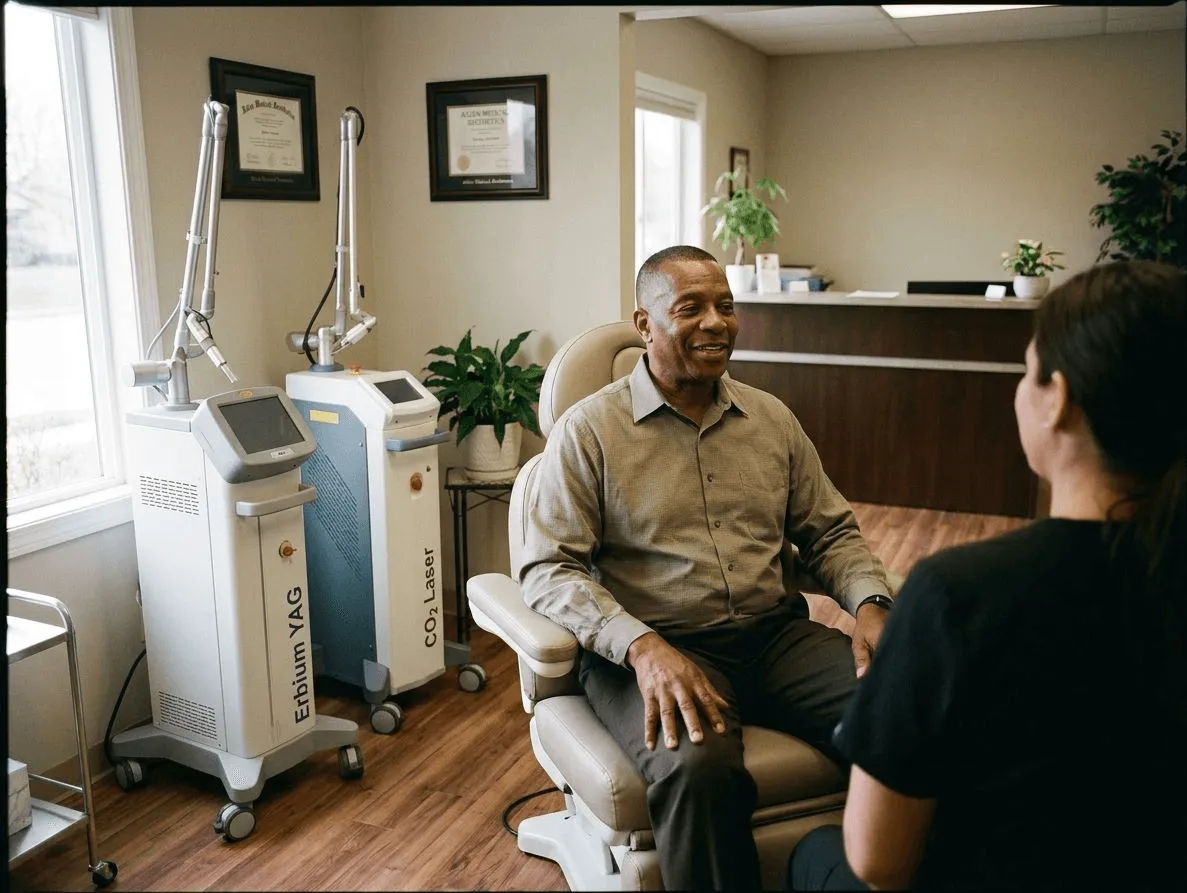
At Allen Medical Aesthetics, we have both erbium YAG and CO2 laser systems available. This dual capability allows us to recommend and perform the treatment that best fits each patient, rather than defaulting to whichever laser happens to be in the office. This guide compares the two technologies across every factor that matters to patients.
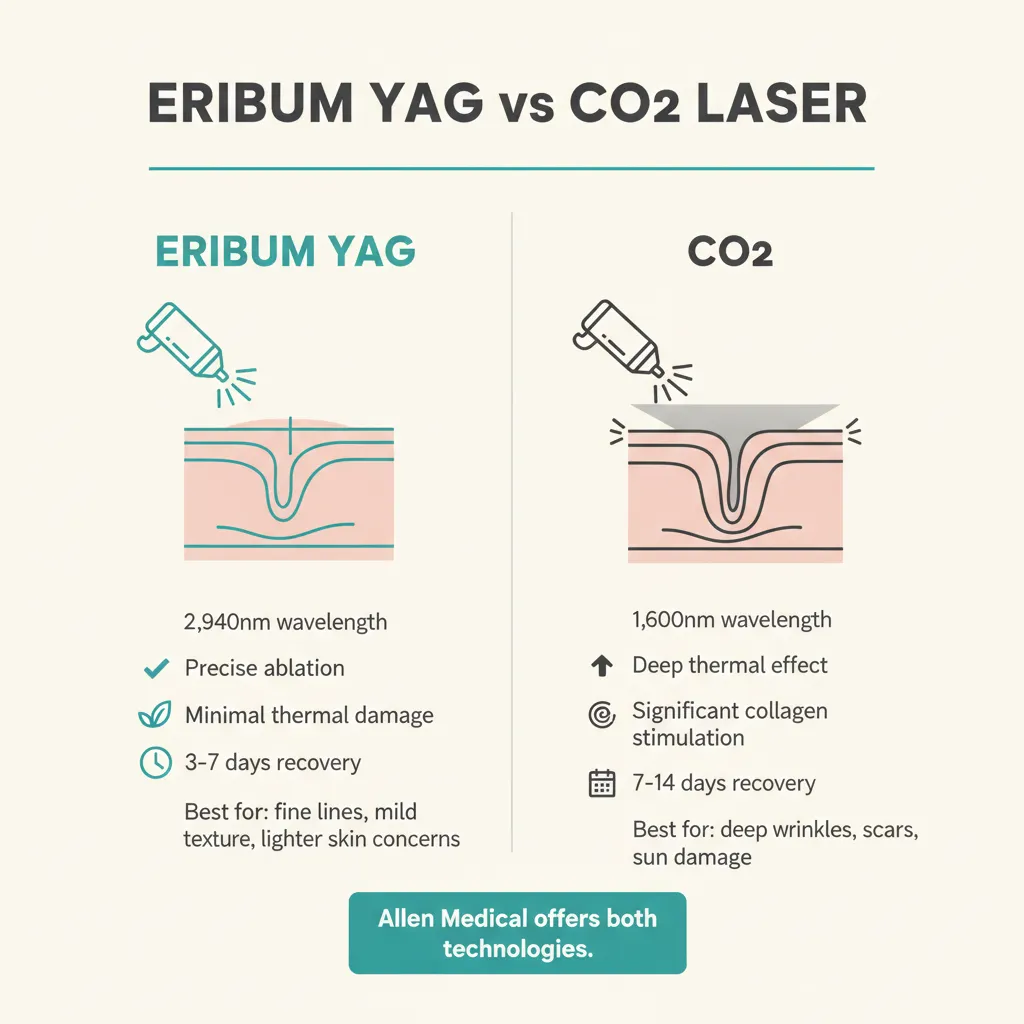
CO2 laser (10,600 nm wavelength) penetrates deeper, produces stronger collagen stimulation, and delivers more dramatic results in a single session, but requires 7 to 14 days of recovery. Erbium YAG laser (2,940 nm wavelength) is more precise, causes less thermal damage, and heals in 5 to 7 days, but produces somewhat less dramatic results per session. CO2 is better for deep scarring and severe sun damage. Erbium is better for moderate concerns, sensitive areas, and patients who need shorter downtime.
Neither laser is universally "better." The right choice depends on your specific concerns, skin type, and how much recovery time you can commit to. The best clinics have access to both technologies.
How Each Laser Works: Wavelength and Mechanism
Both erbium YAG and CO2 lasers are ablative, meaning they physically remove layers of skin. The key difference lies in their wavelengths and how that affects the way energy is absorbed and distributed in the skin.
The CO2 laser operates at a 10,600 nm wavelength. Water in skin cells absorbs this wavelength effectively, causing controlled vaporization of tissue. However, CO2 laser energy also creates a significant zone of residual thermal damage around each treatment area. This thermal injury extends 50 to 150 microns beyond the vaporized tissue. While this sounds like a disadvantage, the thermal damage is actually responsible for much of the collagen-stimulating benefit of CO2 treatment. The heat triggers a strong wound-healing cascade that produces new collagen and elastin over the following months.
The erbium YAG laser operates at a 2,940 nm wavelength, which corresponds to the peak absorption wavelength of water. This means erbium energy is absorbed approximately 10 to 15 times more efficiently by water than CO2 energy. The result is extremely precise tissue removal with a much narrower zone of residual thermal damage (typically 10 to 40 microns). Erbium removes tissue cleanly, almost like a surgical instrument, with minimal collateral heat.
This fundamental difference in thermal effect explains nearly every practical distinction between the two lasers: recovery time, result intensity, risk profile, and ideal candidacy.
Depth of Penetration and Tissue Effect
The depth to which each laser can treat, and the amount of surrounding thermal stimulation it provides, directly impacts results.
CO2 laser can effectively treat to depths of 200 to 300 microns per pass (or deeper with multiple passes), with an additional 50 to 150 microns of thermal coagulation zone. This means a single aggressive CO2 treatment can reach the mid-dermis, where deeper scars and wrinkles originate. The thermal coagulation zone also causes immediate tissue contraction (skin tightening) and a prolonged collagen remodeling response.
Erbium YAG laser ablates tissue at approximately 5 to 10 microns per joule of energy, with only 10 to 40 microns of residual thermal damage per pass. Multiple passes can increase the treatment depth, but the total thermal stimulation remains less than CO2 at equivalent depths. This makes erbium more predictable and precise, but less aggressive in stimulating deep collagen remodeling.
In clinical practice, the choice of depth depends on the concern being treated. Superficial sun damage and fine lines may only require treatment to 100 to 150 microns, which erbium handles beautifully. Deep acne scars or pronounced wrinkles that extend into the mid-dermis benefit from the deeper penetration and stronger thermal effect of CO2.
| Factor | Erbium YAG | CO2 Laser |
|---|---|---|
| Wavelength | 2,940 nm | 10,600 nm |
| Water Absorption | 10 to 15x higher than CO2 | High (baseline reference) |
| Ablation Depth Per Pass | 5 to 10 microns per J/cm2 | 20 to 30 microns per pass |
| Thermal Damage Zone | 10 to 40 microns | 50 to 150 microns |
| Tissue Tightening Effect | Minimal | Significant (collagen contraction) |
| Collagen Stimulation | Moderate | Strong |
Recovery Time Comparison
Recovery is one of the most practical differences between erbium and CO2 laser resurfacing, and it is often the deciding factor for patients choosing between the two.
After erbium YAG treatment, most patients experience 3 to 5 days of redness, mild swelling, and superficial peeling. By day 5 to 7, the skin is typically healed enough for makeup and normal activities. Redness may persist for 1 to 3 weeks but is generally mild and easily concealed. The faster healing is a direct result of the narrower thermal damage zone. Because less surrounding tissue is injured, the skin can repair itself more quickly.
After CO2 laser treatment, patients experience 5 to 7 days of significant redness, swelling, oozing, and peeling, followed by another 5 to 7 days of residual redness and skin sensitivity. Most patients need 7 to 14 days before they feel comfortable returning to work or social activities. Residual pinkness can persist for 4 to 8 weeks. The more extensive recovery reflects the deeper tissue injury and larger thermal damage zone that drives CO2 laser's stronger results.
For patients who cannot take 7 to 14 days away from work or social obligations, erbium YAG offers a compelling compromise. It delivers meaningful resurfacing results with roughly half the downtime of CO2 treatment.
| Recovery Milestone | Erbium YAG | CO2 Laser |
|---|---|---|
| Peak swelling | Day 1 to 2 | Day 2 to 3 |
| Active peeling | Day 2 to 4 | Day 4 to 7 |
| Comfortable with makeup | Day 5 to 7 | Day 10 to 14 |
| Return to work | Day 4 to 7 | Day 7 to 14 |
| Residual redness fades | 1 to 3 weeks | 4 to 8 weeks |
| Full collagen remodeling | 2 to 4 months | 3 to 6 months |
If your schedule allows only one week of downtime, erbium YAG is the safer bet. If you can plan for two weeks, CO2 laser opens up the possibility of more dramatic single-session improvement.
Questions about laser and skin?
Our providers offer consultations to discuss your options. The $50 fee is applied toward your first treatment.
Talk to a ProviderResults Comparison by Skin Concern
Both lasers produce real, measurable improvement, but they excel at different concerns. The table below summarizes how each technology performs for the most common reasons patients seek resurfacing.
| Concern | Erbium YAG Results | CO2 Laser Results | Better Choice |
|---|---|---|---|
| Fine Lines | 40% to 60% improvement | 50% to 70% improvement | Either (erbium for mild, CO2 for moderate) |
| Deep Wrinkles | 30% to 50% improvement | 50% to 70% improvement | CO2 laser |
| Acne Scars (Mild) | 40% to 60% improvement | 50% to 70% improvement | Either |
| Acne Scars (Deep) | 30% to 45% improvement | 50% to 70% improvement | CO2 laser |
| Sun Damage / Photodamage | 50% to 70% improvement | 60% to 80% improvement | Either (both perform well) |
| Skin Texture / Pore Size | 50% to 70% improvement | 60% to 80% improvement | Either (both excel here) |
| Skin Laxity (Tightening) | Minimal tightening | 30% to 50% improvement | CO2 laser |
| Delicate Areas (Eyelids, Lips) | Excellent precision | Higher risk in thin skin | Erbium YAG |
CO2 laser is the clear winner for deep scarring, significant wrinkles, and skin tightening. Erbium YAG is preferred for delicate areas, moderate concerns, and patients who prioritize shorter recovery. For sun damage and texture, both perform very well.
Skin Type and Safety Considerations
Skin type plays an important role in determining which laser is safer and more appropriate for each patient. The Fitzpatrick scale, which classifies skin types from I (very fair) to VI (deeply pigmented), guides laser selection.
CO2 laser carries a higher risk of post-inflammatory hyperpigmentation (PIH) and hypopigmentation, especially in patients with Fitzpatrick types IV through VI. The extensive thermal damage zone affects melanocytes (pigment-producing cells) in the surrounding tissue, which can lead to temporary or permanent changes in skin color. For this reason, CO2 laser is generally recommended for Fitzpatrick types I through III, with cautious use in type IV.
Erbium YAG laser poses a lower risk of pigmentation changes because its narrow thermal damage zone affects fewer melanocytes. This makes erbium a potentially safer option for patients with Fitzpatrick types III and IV. However, even erbium laser carries some risk in darker skin types, and conservative settings with appropriate pre- and post-treatment protocols are essential.
For patients with Fitzpatrick types V and VI, non-ablative treatments like RF microneedling are often recommended as a first-line approach, since they bypass the melanin-targeting mechanism that creates pigmentation risk with ablative lasers.
Can You Combine Erbium and CO2 Laser in One Session?
Yes, and this combination approach is one of the advantages of having both laser systems available in the same practice. At Allen Medical Aesthetics, we sometimes use a hybrid approach in which different lasers are used on different areas of the face within a single treatment session.
For example, a patient with deep acne scarring on the cheeks and fine lines around the eyes might receive CO2 laser on the cheeks (where aggressive treatment is needed and the skin is thicker) and erbium YAG around the eyes (where the skin is thinner and precision matters more). This customized approach delivers the best possible result for each area while minimizing risk.
The decision to combine lasers or use one exclusively is made during your consultation based on your specific anatomy, concerns, skin type, and recovery capacity. Not every patient needs or benefits from a combination approach, but having both technologies available ensures the treatment can be tailored to your needs rather than limited by equipment.
Ask whether your provider has access to both erbium and CO2 laser systems. Practices with only one laser type may recommend that laser for every patient, even when the other technology would be a better fit.
Cost Comparison: Erbium vs CO2
Erbium YAG and CO2 laser resurfacing are priced similarly in many practices, though CO2 treatments tend to cost slightly more due to the increased treatment intensity and post-procedure monitoring required.
Erbium YAG full-face treatment typically ranges from $2,000 to $4,000 per session. CO2 full-face treatment typically ranges from $2,500 to $5,000 per session. However, erbium treatments may require 2 to 3 sessions to achieve results comparable to a single CO2 session, which can affect the total cost of care.
When comparing total investment, consider the number of sessions needed, the cost of post-care products, time away from work, and any follow-up visits. For a detailed breakdown of CO2 laser pricing, see our CO2 laser resurfacing cost guide.
How to Choose: Decision Framework
Choosing between erbium and CO2 laser does not have to be complicated. The decision typically comes down to three factors: the severity of your concerns, your available recovery time, and your skin type.
Choose Erbium YAG If
Erbium YAG is typically the better choice when your concerns are mild to moderate (fine lines, superficial sun damage, mild texture issues), when you can only take 5 to 7 days away from normal activities, when you have Fitzpatrick type III or IV skin and want to minimize pigmentation risk, when you need treatment on delicate areas like the eyelids or upper lip, or when you prefer a lower-risk procedure even if it means needing an additional session.
Choose CO2 Laser If
CO2 laser is typically the better choice when your concerns are moderate to severe (deep acne scars, pronounced wrinkles, significant sun damage), when you can commit to 7 to 14 days of recovery, when you have Fitzpatrick type I to III skin, when skin tightening is a secondary goal, or when you want to maximize results in a single session.

“Having both erbium and CO2 lasers in our practice means I can match the treatment to the patient rather than the other way around. For someone with deep scarring who can take two weeks off, CO2 is the clear choice. For a patient who needs to be back at work in a week but still wants real improvement, erbium gives us that flexibility.”
Therese Allen, MSN, RN Lead Aesthetic Nurse Injector
Frequently Asked Questions
Is erbium laser safer than CO2 laser?
Erbium YAG has a narrower margin of thermal damage, which translates to lower risk of pigmentation changes, faster healing, and fewer complications overall. However, both lasers are safe when performed by qualified providers using appropriate settings for your skin type.
Which laser is better for acne scars?
For deep or severe acne scars, CO2 laser typically produces superior results due to its deeper penetration and stronger collagen stimulation. For mild to moderate scarring, erbium YAG can produce excellent results with less downtime. At Allen Medical Aesthetics, we assess scar severity during consultation to recommend the best approach.
Can erbium laser tighten skin?
Erbium YAG produces minimal skin tightening compared to CO2 laser. The tightening effect of CO2 comes from its larger thermal damage zone, which causes collagen contraction and tissue remodeling. If skin laxity is a significant concern, CO2 laser or RF microneedling may be better options.
How many erbium sessions equal one CO2 session?
This depends on the concern and treatment intensity, but as a general guideline, 2 to 3 erbium YAG sessions produce results roughly comparable to 1 CO2 session for most concerns. The trade-off is shorter recovery per session with erbium.
Does Allen Medical Aesthetics have both lasers?
Yes. Allen Medical Aesthetics has both erbium YAG and CO2 fractional laser systems. This allows us to customize each treatment based on the patient's specific concerns, skin type, and recovery preferences. We can even combine both lasers in a single session when appropriate.
Which laser is better for dark skin?
Erbium YAG carries a lower risk of pigmentation changes than CO2 laser, making it the safer ablative option for Fitzpatrick types III and IV. For types V and VI, non-ablative treatments like RF microneedling are generally recommended as a first-line approach to minimize pigmentation risk.
Is the erbium laser less painful than CO2?
Both lasers are performed with topical numbing, and discomfort during the procedure is generally manageable with either technology. Post-procedure discomfort is somewhat less with erbium due to the narrower thermal damage zone. Most patients describe CO2 recovery as feeling like a moderate sunburn, while erbium recovery feels milder.
Related Articles
This article supports our Co2 Laser Resurfacing service page. Learn more about treatment options, candidacy, and what to expect.