

One of the most common questions we hear at Allen Medical Aesthetics is straightforward: how long will my Botox last? The short answer is 3 to 4 months for most patients. The longer answer involves your treatment area, metabolism, dosing, lifestyle, and how consistently you maintain your appointments.
Understanding what influences Botox duration helps you plan your treatment schedule, budget accurately, and get the most out of every session. This guide breaks down exactly what to expect, area by area, and shares evidence-based strategies that can genuinely extend your results.
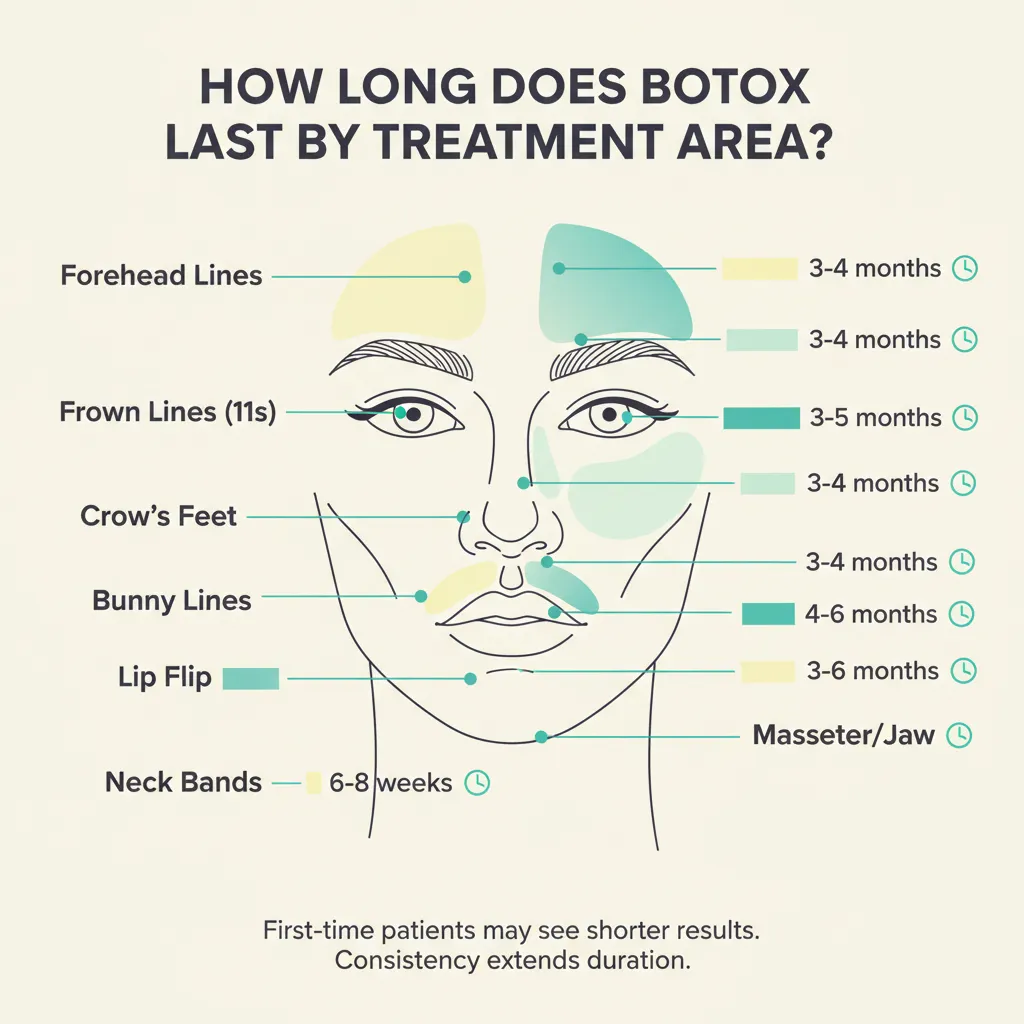
Botox results typically last 3 to 4 months for most patients. Duration varies by treatment area: forehead and crow's feet average 3 to 4 months, frown lines can last 3 to 5 months, and masseter treatments often last 4 to 6 months. Individual factors like metabolism, dose, and treatment consistency also affect how long results last.
Plan for re-treatment every 3 to 4 months to maintain consistent results. Patients who stay on a regular schedule often find their results last progressively longer over time.
How Botox Works: The Mechanism Behind the Results
To understand why Botox wears off, it helps to understand how it works in the first place. Botox (onabotulinumtoxinA) is a purified protein that temporarily blocks the release of acetylcholine at the neuromuscular junction. Acetylcholine is the chemical messenger that triggers muscle contraction. When Botox prevents its release, the targeted muscle can no longer contract with its usual force, and the overlying skin relaxes and smooths.
The effect is not permanent because your body continuously works to repair the disrupted nerve signaling. Over weeks and months, new nerve endings sprout and re-establish communication with the muscle. This process, called axonal sprouting, is gradual. You will not wake up one morning with all your wrinkles back. Instead, you will notice a slow, progressive return of muscle movement over several weeks.
This mechanism is also why consistent treatment matters. When muscles remain relaxed for extended periods through regular Botox sessions, the muscle fibers themselves can weaken and atrophy slightly. Weaker muscles require less product to relax and may stay smoother for longer between treatments. Patients who have been getting Botox consistently for several years often report that their results last longer than they did during their first year of treatment.
Botox Duration by Treatment Area
Not all treatment areas respond to Botox the same way. Larger, stronger muscles tend to metabolize the product differently than smaller, thinner muscles. The table below provides a general framework for what to expect by area, though individual results will vary.
| Treatment Area | Typical Duration | Factors Affecting Duration |
|---|---|---|
| Forehead Lines (Frontalis) | 3 to 4 months | Very active muscle; patients who raise their brows frequently may metabolize faster |
| Frown Lines / 11s (Glabellar) | 3 to 5 months | Strong muscles; adequate dosing is critical for full duration |
| Crow's Feet (Orbicularis Oculi) | 3 to 4 months | Thin muscle; tends to respond well but wears off gradually |
| Bunny Lines (Nasalis) | 3 to 4 months | Small muscle; requires fewer units |
| Lip Lines / Lip Flip | 2 to 3 months | Very active muscle used in speaking and eating; tends to wear off faster |
| Chin Dimpling (Mentalis) | 3 to 4 months | Moderate muscle activity; responds consistently |
| Masseter / Jaw (TMJ / Slimming) | 4 to 6 months | Large, thick muscle; higher doses last longer; muscle atrophy extends results over time |
| Neck Bands (Platysma) | 3 to 4 months | Broad, thin muscle; results depend on severity of banding |
| Hyperhidrosis (Underarms) | 6 to 12 months | Targets sweat glands rather than muscles; significantly longer duration |
The masseter and hyperhidrosis areas tend to deliver the longest-lasting results. Upper-face treatments (forehead, frown lines, crow's feet) typically need re-treatment every 3 to 4 months for consistent results.
Factors That Can Shorten Your Botox Results
If your Botox seems to wear off faster than expected, one or more of these factors may be contributing. Understanding what accelerates metabolism of the product can help you and your provider make adjustments.
High Metabolism and Physical Activity
Patients with faster metabolisms tend to process Botox more quickly. Intense cardiovascular exercise, particularly activities that significantly raise your heart rate for extended periods, can increase blood flow to the treated area and may accelerate the breakdown of the product. This does not mean you should avoid exercise. It simply means that endurance athletes and highly active individuals may find their Botox wears off a few weeks earlier than average.
If you exercise intensely most days, let your provider know. They can adjust your dose or recommend a slightly shortened re-treatment interval to maintain consistent results.
Underdosing
One of the most common reasons Botox does not last as long as expected is insufficient dosing. When a muscle does not receive enough units to fully relax it, the partial effect wears off more quickly. Conservative dosing in an attempt to save money can actually cost more over time because you need more frequent treatments.
An experienced injector will recommend the right dose for your specific anatomy and muscle strength. At Allen Medical Aesthetics, we would rather dose you properly the first time than have you return in 6 weeks because the effect has already faded.
Sun Exposure and Heat
Excessive sun exposure and heat can increase inflammation in the skin and may influence how quickly your body metabolizes Botox. While the evidence is not conclusive, many patients report that their summer results do not last as long as their fall or winter results. Consistent sun protection benefits both your Botox longevity and your overall skin health.
Stress
Chronic stress increases cortisol levels, which can affect muscle tension and inflammation throughout the body. Patients going through periods of high stress sometimes notice their Botox wearing off earlier than usual. Facial tension associated with stress, such as habitual frowning or jaw clenching, can also work against the relaxing effects of the product.
Questions about injectables?
Our providers offer consultations to discuss your options. The $50 fee is applied toward your first treatment.
Talk to a Provider
“The two biggest factors I see affecting how long Botox lasts are dosing and consistency. Patients who are properly dosed from the start and come back before their results have fully worn off almost always see their longevity improve over time. Underdosing to save a few dollars upfront usually means shorter results and more frequent visits, which ends up costing more.”
Therese Allen, MSN, RN Lead Aesthetic Nurse Injector
Factors That Can Extend Your Botox Results
While some factors are out of your control, several evidence-based strategies can help you get the most out of every Botox session. For a deep dive on this topic, see our guide on how to make Botox last longer.
Consistent Treatment Schedule
The single most effective strategy for extending Botox duration is staying on a regular treatment schedule. Patients who return for re-treatment before their Botox has fully worn off, rather than waiting until all movement returns, tend to see progressively longer-lasting results over time. The muscle weakens with consistent relaxation, eventually requiring less product to maintain the same effect.
Proper Dosing
Adequate dosing from the start is essential. If the muscle is fully relaxed, the effect lasts longer than if it is only partially treated. Trust your provider's dose recommendation rather than requesting fewer units to reduce cost. Proper dosing is the foundation of lasting results.
Zinc Supplementation
Botulinum toxin is a zinc-dependent enzyme, and some providers theorize that ensuring adequate zinc levels may support its activity and help extend results. The evidence for this remains preliminary, but some providers recommend a zinc supplement (such as Zytaze) starting a few days before treatment. Discuss this with your provider before starting any supplement.
Sun Protection and Skincare
Protecting your skin from UV damage with daily SPF and a consistent skincare routine supports overall skin health, which can complement your Botox results. Retinoids, peptides, and antioxidants help maintain skin quality between treatments and may enhance the visual results of your neurotoxin.
First-Time vs Repeat Patient: What to Expect
If you are getting Botox for the first time, your experience may differ from what long-term patients describe. Understanding the typical progression helps set realistic expectations.
First-time patients often notice that their initial treatment does not last quite as long as subsequent treatments. This is normal. During your first session, the muscles being treated are at full strength, and the Botox is working against their maximum contractile force. Results from a first treatment typically last 2.5 to 3.5 months.
By the second and third treatments, the targeted muscles have been relaxed for an extended period and have begun to weaken slightly. This means the Botox has less resistance to overcome, and the effect tends to last longer. Many patients report that by their third or fourth treatment, results are lasting a solid 3.5 to 4 months.
After a year or more of consistent treatment, some patients find they can extend their interval to 4 to 5 months between sessions while still maintaining smooth, natural-looking results. This is the cumulative benefit of consistent treatment, and it is one of the strongest arguments for staying on schedule rather than treating Botox as an occasional indulgence.
When to Schedule Your Next Appointment
Timing your re-treatment correctly is important for maintaining consistent results and maximizing the cumulative benefit of regular Botox. The general recommendation is to schedule your next appointment when you first notice movement returning, not when the Botox has fully worn off.
For most patients, this means booking at the 10- to 14-week mark after treatment. If you wait until your wrinkles have fully returned (often 16 to 20 weeks), the muscles have had time to regain full strength, and you are essentially starting from scratch each time. Re-treating while some residual effect remains allows the muscle to stay in a weakened state, which extends results over time.
At Allen Medical Aesthetics, we recommend scheduling your follow-up appointment before you leave the office. We will suggest a specific timeframe based on your treatment area, dose, and how your body responded to previous sessions. If you are a new patient, we typically schedule a 2-week follow-up to assess your results and determine whether any touch-up is needed.
What Happens When Botox Wears Off
One concern we hear from patients considering Botox for the first time is whether their wrinkles will be worse if they stop treatment. The reassuring answer is no. When Botox wears off, your muscles gradually return to their pre-treatment level of activity. Your wrinkles will not be deeper or more pronounced than they were before you started.
In fact, patients who have been getting Botox consistently for several years and then stop treatment often look better than they would have without ever having had Botox. This is because the muscles have been weakened during the treatment period, slowing the deepening of dynamic wrinkles. The preventive effect of Botox is real and measurable.
The wearing-off process is gradual, not sudden. Most patients first notice subtle movement returning in the treated area around weeks 8 to 10. Over the following 4 to 6 weeks, movement progressively increases until the muscle is back to full activity. At no point does the effect disappear overnight.
Botox does not make wrinkles worse when it wears off. If you stop treatment, your muscles simply return to their pre-treatment baseline. Years of consistent Botox actually slows the progression of dynamic wrinkles.
Botox vs Dysport vs Xeomin: Duration Compared
Patients often ask whether one neurotoxin lasts longer than the others. The table below compares the three most commonly used products. For a detailed breakdown of how Botox and Dysport differ beyond duration, see our Botox vs Dysport comparison guide.
In clinical practice, the difference in duration between Botox, Dysport, and Xeomin is minimal when each product is dosed appropriately. Daxxify is the notable exception, generally lasting significantly longer due to its peptide stabilization technology. Allen Medical Aesthetics offers all of these options so we can match each patient with the ideal product for their needs.
| Neurotoxin | Typical Onset | Average Duration | Notes |
|---|---|---|---|
| Botox (onabotulinumtoxinA) | 3 to 5 days | 3 to 4 months | Most extensively studied; gold standard |
| Dysport (abobotulinumtoxinA) | 1 to 3 days | 3 to 4 months | Faster onset; wider diffusion pattern |
| Xeomin (incobotulinumtoxinA) | 3 to 5 days | 3 to 4 months | No complexing proteins; may reduce antibody risk |
| Daxxify (daxibotulinumtoxinA) | 1 to 2 days | 6 to 9 months | Newest option; peptide-powered for extended duration |
Frequently Asked Questions
How long does Botox last the first time?
First-time Botox patients typically see results lasting 2.5 to 3.5 months. The duration tends to increase with subsequent treatments as the targeted muscles weaken from consistent relaxation.
Does Botox last longer in certain areas of the face?
Yes. Masseter (jaw) treatments tend to last 4 to 6 months because the muscle atrophies with repeated treatment. Lip treatments tend to wear off fastest (2 to 3 months) because the lip muscles are highly active. Forehead, frown lines, and crow's feet fall in the middle at 3 to 4 months.
Why does my Botox only last 2 months?
If your Botox is wearing off in 2 months, the most common reason is underdosing. Other factors include a fast metabolism, intense exercise, high stress, or being a first-time patient. Discuss this with your provider, as adjusting the dose or switching products may help.
Can Botox last 6 months?
For standard upper-face treatments, Botox lasting 6 months is uncommon but not impossible, particularly in long-term patients with weakened muscles. Masseter treatments can last 4 to 6 months, and Botox for hyperhidrosis (excessive sweating) can last 6 to 12 months. Daxxify is specifically designed to last 6 to 9 months.
Will my wrinkles be worse if I stop getting Botox?
No. When Botox wears off, your muscles return to their pre-treatment level of activity. Your wrinkles will not be deeper or more pronounced than they would have been without treatment. In fact, years of consistent Botox can slow the progression of dynamic wrinkles.
How often should I get Botox to maintain results?
Most patients benefit from Botox every 3 to 4 months. The ideal schedule is to re-treat when you first notice movement returning, typically around the 10- to 14-week mark, rather than waiting until the effect has fully worn off.
Does exercise make Botox wear off faster?
Intense cardiovascular exercise may slightly accelerate Botox metabolism due to increased blood flow and metabolic activity. However, moderate exercise does not significantly affect duration. If you are a high-intensity athlete, your provider can adjust your dose or treatment interval accordingly.
Does Botox last longer with more units?
Proper dosing can extend duration because fully relaxed muscles take longer to regain activity. However, there is a ceiling to this effect. Adding excessive units beyond what is clinically appropriate does not proportionally extend results and can increase the risk of an unnatural appearance.
Related Articles
This article supports our Botox Wrinkle Relaxers service page. Learn more about treatment options, candidacy, and what to expect.