
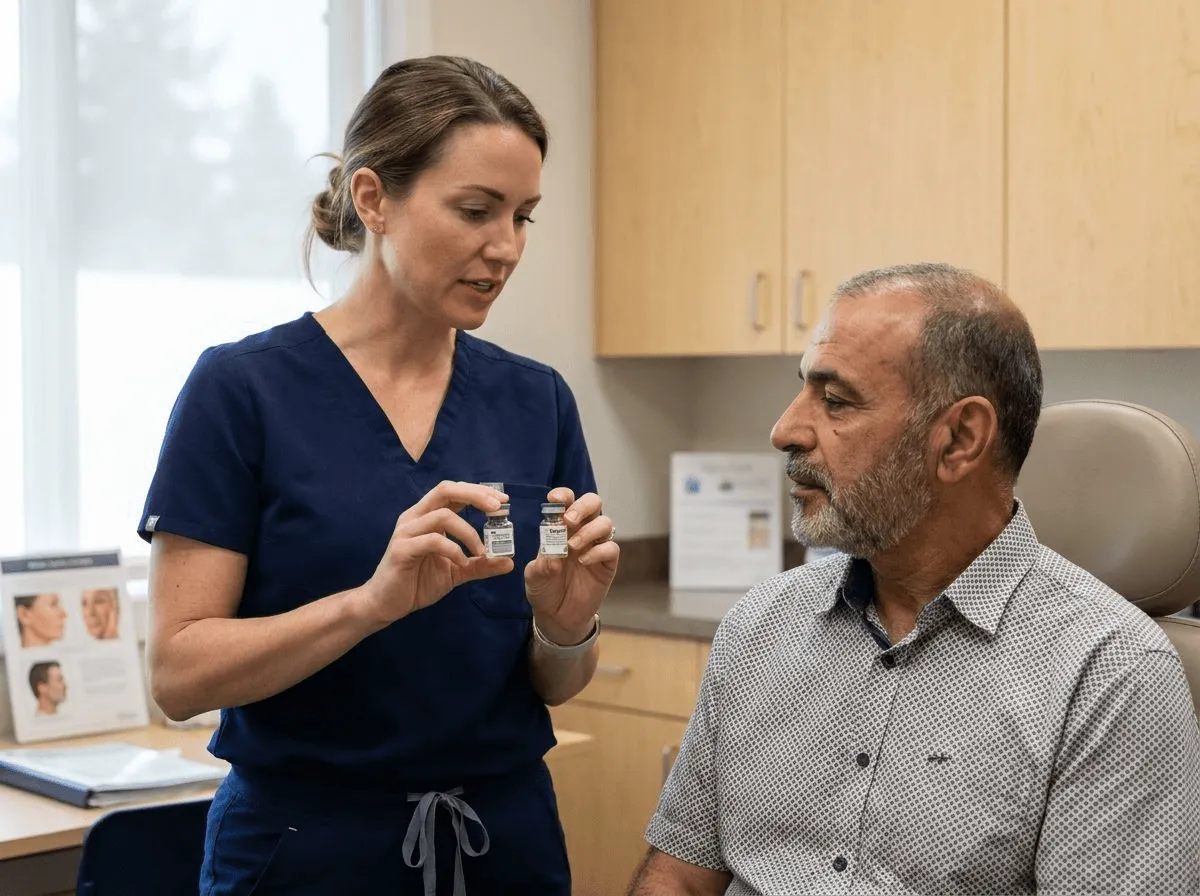
If you are researching wrinkle relaxers, you have probably seen two names dominate the conversation: Botox and Dysport. Both are neuromodulators that temporarily smooth dynamic wrinkles, and both have decades of clinical use behind them. Yet they are not identical products. Differences in formulation, onset speed, diffusion patterns, and cost per treatment area mean that one may suit your goals better than the other.
At Allen Medical Aesthetics in Des Moines, WA, we carry all four neurotoxins: Botox, Dysport, Xeomin, and Jeuveau. That means we never default to a single brand. Instead, we match each patient with the product that best fits their anatomy, treatment area, lifestyle, and budget. This guide walks you through every meaningful difference so you can arrive at your consultation already informed.
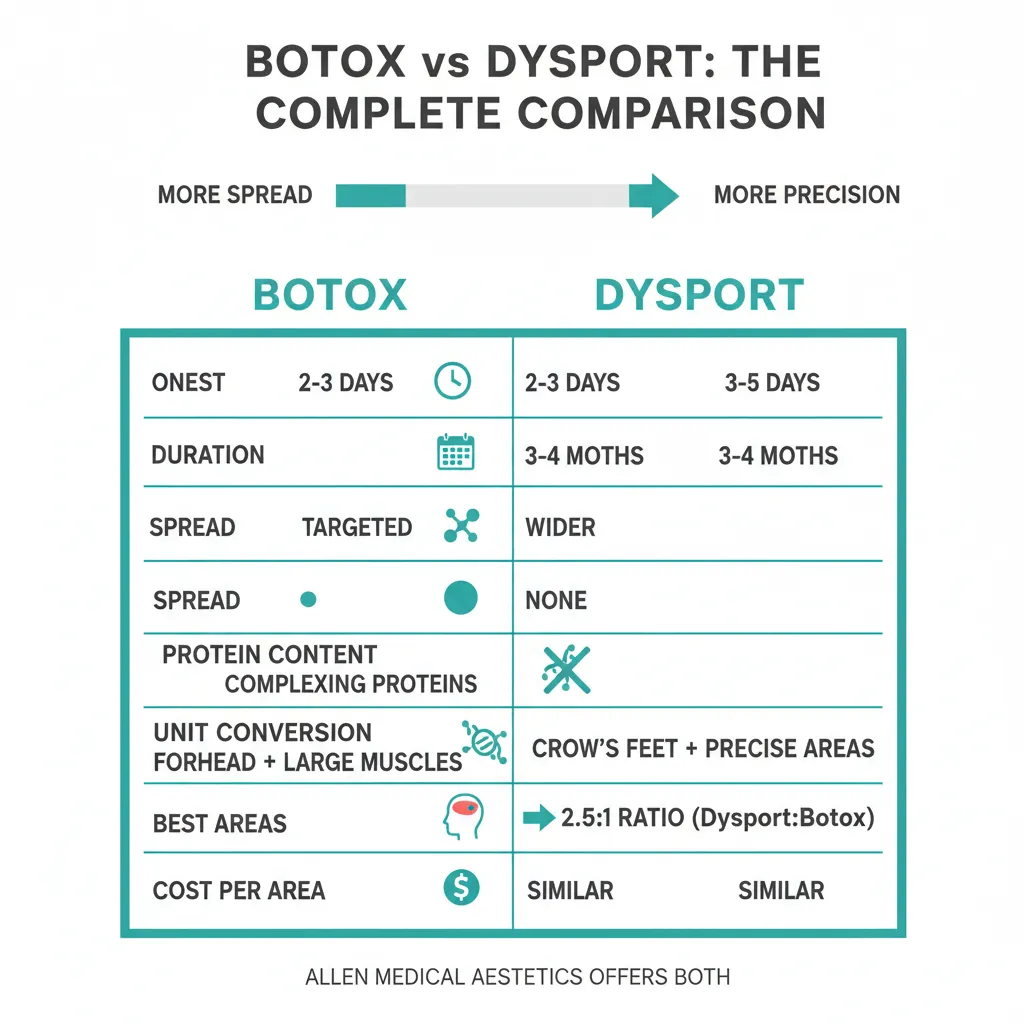
Botox and Dysport both relax muscles to smooth wrinkles. Dysport typically kicks in 1 to 2 days faster and spreads over a wider area, making it a strong choice for broad regions like the forehead. Botox offers more precise, concentrated placement and has the longest track record. Results from both generally last 3 to 4 months.
Neither product is universally better. The right choice depends on your treatment area, how quickly you want to see results, and your provider's assessment of your facial anatomy.
What Are Neuromodulators and How Do They Work?
Neuromodulators are injectable treatments derived from botulinum toxin type A. When injected into specific facial muscles, they temporarily block the release of acetylcholine, the chemical signal that tells muscles to contract. Without that signal, the targeted muscle relaxes, and the overlying skin smooths out. The result is softer forehead lines, reduced crow's feet, and diminished frown lines between the brows.
The effect is temporary because your body gradually regenerates the nerve endings that were blocked. Over the course of three to four months, muscle activity returns and the wrinkles reappear. Consistent treatment on a regular schedule can train the muscles to stay relaxed longer over time, which is why many patients find their results last progressively longer with each session.
All four neurotoxins, including Botox (onabotulinumtoxinA), Dysport (abobotulinumtoxinA), Xeomin (incobotulinumtoxinA), and Jeuveau (prabotulinumtoxinA), share this core mechanism. Where they differ is in their molecular structure, protein content, unit measurement, and diffusion behavior. These differences are subtle but clinically meaningful.
Botox vs Dysport: Head-to-Head Comparison
The table below summarizes the key clinical and practical differences between Botox and Dysport. Keep in mind that unit measurements are not interchangeable. One unit of Botox is not equivalent to one unit of Dysport, which is why direct price-per-unit comparisons can be misleading.
| Factor | Botox (onabotulinumtoxinA) | Dysport (abobotulinumtoxinA) |
|---|---|---|
| Manufacturer | Allergan (AbbVie) | Galderma |
| Complexing Proteins | Yes (900 kDa complex) | Yes (smaller complex, ~500 kDa) |
| Onset of Action | 3 to 5 days | 1 to 3 days |
| Peak Results | 10 to 14 days | 7 to 10 days |
| Duration | 3 to 4 months | 3 to 4 months |
| Diffusion / Spread | More concentrated, stays closer to injection site | Spreads more broadly from injection site |
| Unit Conversion Ratio | 1 unit Botox | 2.5 to 3 units Dysport |
| Typical Forehead Dose | 10 to 30 units | 25 to 75 units |
| Typical Glabellar (Frown) Dose | 20 units | 50 units |
| Average Cost per Treatment Area | $250 to $600 | $250 to $600 |
Because Dysport uses a different unit measurement than Botox, comparing price per unit is misleading. Cost per treatment area is the most accurate way to compare. When properly dosed, Botox and Dysport typically cost about the same per area treated.
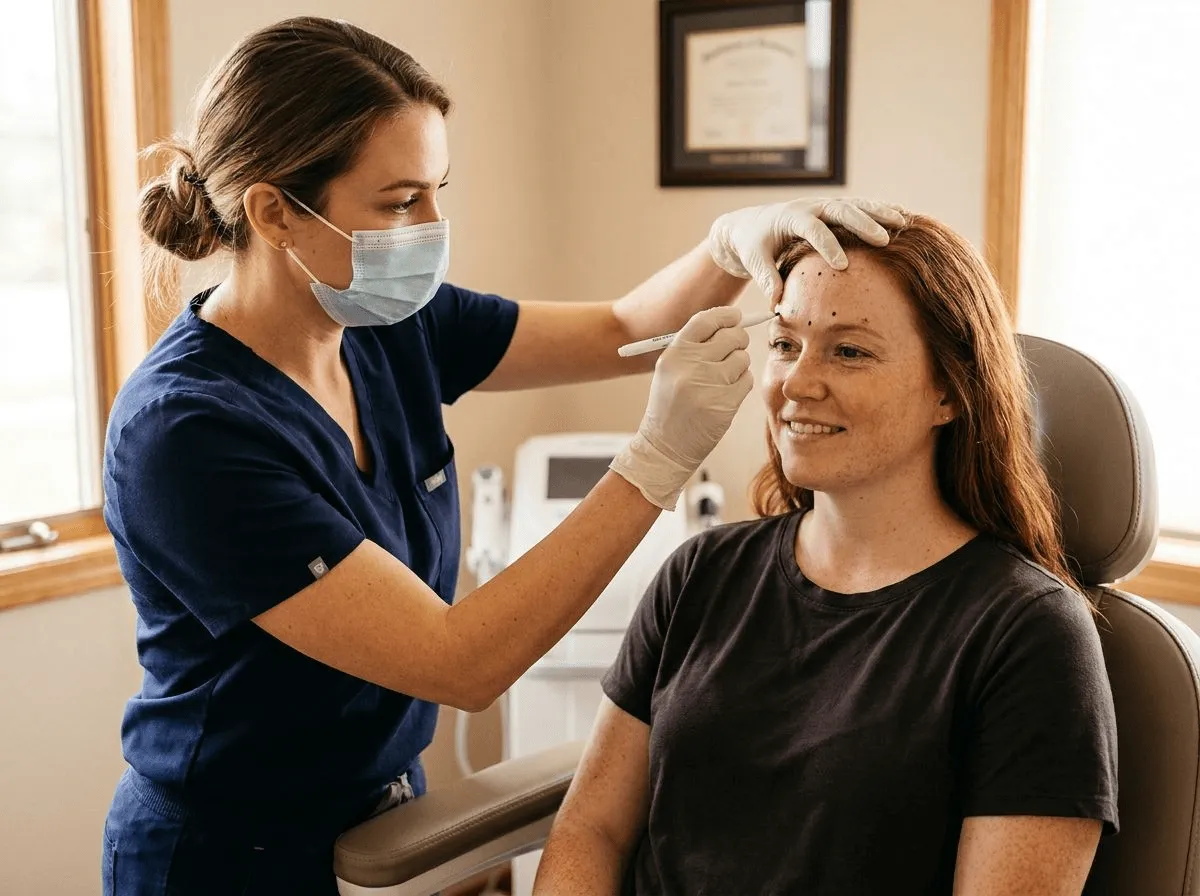
How Each Works Differently at the Molecular Level
Both Botox and Dysport contain botulinum toxin type A as their active ingredient, but their formulations differ in important ways. Botox is formulated as a 900 kilodalton (kDa) complex, meaning the active toxin molecule is surrounded by a larger cluster of protective proteins. Dysport uses a smaller protein complex of roughly 500 kDa. This size difference influences how each product behaves after injection.
The smaller molecular complex in Dysport is widely believed to be the reason it diffuses more readily through tissue. After injection, Dysport tends to spread over a slightly wider area compared to Botox. This can be advantageous in large, flat treatment zones like the forehead, where even coverage across a broad muscle is desirable. It can also be a disadvantage in areas where precision is critical, such as around the delicate muscles near the eyelid.
Botox's larger complex tends to stay more localized at the injection site. This makes it particularly well suited for targeted treatments where the provider wants the effect confined to a specific muscle, such as the corrugator muscles between the brows or the orbicularis oculi around the eyes. In experienced hands, both products can be used effectively in all treatment areas, but many injectors develop a preference based on the specific zone they are treating.
Another difference worth noting is the protein load. Because Dysport uses a higher unit count per treatment (roughly 2.5 to 3 Dysport units for every 1 Botox unit), some researchers have theorized that the increased protein exposure could potentially trigger antibody formation over time. However, there is no established meaningful difference in antibody resistance between the two products at standard cosmetic doses.
Questions about injectables?
Our providers offer consultations to discuss your options. The $50 fee is applied toward your first treatment.
Talk to a ProviderBest Use Cases by Treatment Area
While both products can treat wrinkles and fine lines anywhere on the upper face, certain characteristics make one a stronger fit depending on where you are being treated. Below is how experienced injectors typically approach the decision.
Forehead Lines
The frontalis muscle spans the entire width of the forehead, making it one of the broadest muscles treated with neurotoxins. Dysport's wider diffusion pattern can be beneficial here because fewer injection points may be needed to achieve even coverage. Patients who want a smooth, natural-looking forehead often respond well to Dysport in this area.
Botox works well for the forehead too, but may require slightly more injection points to achieve the same even spread. Providers who prefer Botox in this area appreciate the control it offers, as they can precisely modulate muscle activity to avoid an overly frozen look.
Frown Lines (Glabellar Complex)
The glabellar region between the brows involves three muscles: the corrugator supercilii, the procerus, and the depressor supercilii. Both Botox and Dysport are commonly used for this area, and both perform exceptionally well. Many providers consider this area a toss-up, though some prefer Botox's precision when treating patients with strong, asymmetric corrugator muscles.
Crow's Feet
Crow's feet involve the orbicularis oculi, a thin muscle surrounding the eye. Botox is more commonly used for crow's feet, though Dysport is used in this area as well. Because the skin around the eyes is delicate and the margin for error is small, many injectors favor Botox's more concentrated placement in this area. However, skilled providers achieve excellent crow's feet results with Dysport as well, typically using slightly adjusted placement.
Masseter (Jawline Slimming)
Masseter treatment for jawline slimming and TMJ relief requires a substantial dose injected into a thick, powerful muscle. Both products work, but the higher unit count of Dysport can feel more cost-effective in this area. Results from masseter treatments typically last 4 to 6 months, longer than upper-face treatments, regardless of which product is used.
Real-World Differences Patients Actually Notice
Clinical data and molecular science aside, patients care most about how a treatment feels and looks in daily life. Here are the practical differences most patients report after experiencing both products.
Speed of results is the most commonly noticed difference. Dysport patients frequently report seeing initial smoothing within 24 to 48 hours, while Botox patients typically wait 3 to 5 days. For someone preparing for an event or milestone, this faster onset can be a deciding factor. If your wedding, reunion, or photo shoot is in 10 days, Dysport gives you a head start.
Natural movement is another frequent observation. Because Dysport diffuses more, some patients feel it creates a softer, more gradual transition between treated and untreated areas. Others prefer the crispness that Botox provides, where treated muscles are clearly relaxed while surrounding muscles remain fully active. Neither approach is objectively better. It depends on your aesthetic preference.
Duration is where patients notice the least difference, with both products generally lasting a similar amount of time. Some patients report that Dysport wears off a week or two earlier, while others find it lasts just as long. Individual metabolism, treatment area, and dosing accuracy have a much larger impact on duration than the product itself.
If you have been using Botox and are curious about Dysport (or vice versa), ask your provider about trying the alternate product at your next appointment. Switching is safe, and experiencing both is the best way to determine your personal preference.

“I find that the best way to choose between Botox and Dysport is to consider the treatment area and your personal priorities. If a patient wants results fast (maybe before an event), I often lean toward Dysport for its quicker onset. For precise work around the eyes, I tend to reach for Botox. Having all four neurotoxins in our clinic means I can truly customize each visit.”
Anna Yi, MSN, ARNP Aesthetic & Functional Wellness Nurse Practitioner
How Providers Choose Between Botox and Dysport
An experienced injector does not choose a neurotoxin at random. The decision is guided by several clinical factors that come together during your consultation and assessment.
Treatment area is the first consideration. As discussed above, broader zones may favor Dysport while precision zones may favor Botox. Muscle strength matters as well. A patient with very strong corrugator muscles creating deep frown lines may benefit from Botox's concentrated delivery, while someone with mild forehead lines might respond beautifully to Dysport's gentler diffusion.
Patient history also plays a role. If you have been using one neurotoxin consistently and are happy with the results, there is rarely a reason to switch. If your results have been plateauing or wearing off more quickly, switching to a different product can sometimes refresh the response. This is because different formulations stimulate slightly different antibody profiles, so alternating products may help maintain long-term effectiveness.
At Allen Medical Aesthetics, we also consider your lifestyle and schedule. A patient who needs results fast before a big event may lean toward Dysport for its quicker onset. Someone who prioritizes precise, targeted treatment may prefer Botox. We discuss all of these factors before any injection is administered.
Cost Breakdown: Botox vs Dysport
Cost is one of the most common questions patients ask, and it is also where the most confusion arises. Because Botox and Dysport use different unit measurements, a per-unit price comparison is not meaningful. Comparing cost per treatment area is the only accurate approach.
On average, Dysport's per-unit price is lower than Botox's per-unit price. However, because you need roughly 2.5 to 3 times as many Dysport units to achieve the same effect, the total cost per treatment area is usually comparable. In practice, most patients pay between $250 and $600 per treatment area for either product, depending on the dose required.
Many clinics, including Allen Medical Aesthetics, offer loyalty programs through each brand. Allergan's Alle program rewards Botox patients with points toward future treatments, while Galderma's Aspire program does the same for Dysport. These programs can meaningfully reduce your per-treatment cost over time, so ask about enrollment at your next visit.
| Treatment Area | Botox Units (Typical) | Dysport Units (Typical) | Estimated Cost Range |
|---|---|---|---|
| Forehead Lines | 10 to 30 units | 25 to 75 units | $200 to $500 |
| Frown Lines (Glabellar) | 20 to 25 units | 50 to 65 units | $250 to $500 |
| Crow's Feet (Both Sides) | 12 to 24 units | 30 to 60 units | $200 to $450 |
| Full Upper Face (3 Areas) | 40 to 64 units | 100 to 160 units | $500 to $1,200 |
| Masseter / Jaw Slimming | 25 to 50 units per side | 60 to 120 units per side | $400 to $1,000 |
Safety and Side Effects: How They Compare
Both Botox and Dysport have well-established safety profiles supported by decades of clinical use. The most common side effects are the same for both products and are almost always mild and temporary.
Injection-site reactions including redness, swelling, and minor bruising are the most frequently reported side effects. These typically resolve within a few hours to a few days. Headache can occur after treatment, though it is usually mild and short-lived. Less common side effects include temporary eyelid drooping (ptosis), which can happen if the product migrates to the levator palpebrae muscle. This risk exists with both products but may be slightly higher with Dysport in the glabellar region due to its broader diffusion pattern.
Serious side effects are extremely rare at cosmetic doses. Both products carry a theoretical risk of toxin spread beyond the injection site, which could cause symptoms such as difficulty swallowing or breathing. However, this risk is primarily associated with therapeutic doses used for medical conditions (like spasticity), not the small cosmetic doses used for wrinkle treatment.
Patients with neuromuscular disorders such as myasthenia gravis or Lambert-Eaton syndrome should avoid all neurotoxins. Pregnant or breastfeeding individuals should also avoid treatment, as safety data for these populations is not available.
If you experience any unexpected symptoms such as difficulty swallowing, speaking, or breathing after neurotoxin treatment, seek immediate medical attention. These events are extremely rare but require prompt evaluation.
Can You Switch Between Botox and Dysport?
Yes, switching between Botox and Dysport is safe and common. Many patients try both products over time to determine which they prefer. Some patients even alternate between products at different appointments, either by choice or based on their provider's recommendation.
There is no required washout period between products. If you are currently using Botox and want to try Dysport at your next session (or vice versa), you simply wait for your normal re-treatment window (typically 3 to 4 months) and switch. Your provider will adjust the dose using the appropriate conversion ratio to ensure consistent results.
One reason providers may suggest switching is if a patient's results seem to be diminishing over time. While true immunoresistance to botulinum toxin is rare, alternating between different formulations can sometimes improve response in patients who feel their current product is not lasting as long as it used to.
At Allen Medical Aesthetics, we carry Botox, Dysport, Xeomin, and Jeuveau. Having all four options means we can always pivot to a different product if your needs change, without requiring you to visit a different clinic.
Frequently Asked Questions
Is Dysport cheaper than Botox?
Dysport has a lower price per unit than Botox, but you need roughly 2.5 to 3 times as many units of Dysport to achieve the same effect. When you compare cost per treatment area, both products typically fall in a similar range of $250 to $600 per area. The total cost of your treatment depends on the number of areas treated and the dose your provider recommends.
Does Dysport last longer than Botox?
Botox and Dysport generally have similar durations of 3 to 4 months for most patients. Some individuals report that one product lasts slightly longer for them than the other, but this varies from person to person. Factors like metabolism, treatment area, and dose accuracy have a larger impact on duration than the product itself.
Does Dysport work faster than Botox?
Yes, Dysport typically has a faster onset of action. Many patients notice initial results within 1 to 3 days with Dysport, compared to 3 to 5 days for Botox. Full results from both products are usually visible within 10 to 14 days.
Can my provider use Botox on one area and Dysport on another at the same visit?
While it is technically safe, most providers prefer to use one product per visit for consistency in tracking results and managing any side effects. If you want to try both, your provider may suggest using different products at alternating appointments.
Will I look frozen with Botox or Dysport?
A frozen look is the result of technique and dosing, not the product itself. An experienced injector can achieve natural-looking results with either Botox or Dysport. At Allen Medical Aesthetics, we prioritize subtle, natural results that soften wrinkles while preserving your expressions.
How do I know which one is right for me?
The best way to determine which product suits you is through a consultation with an experienced injector. Your provider will assess your facial anatomy, muscle strength, treatment goals, and any previous experience with neurotoxins to recommend the best option. At Allen Medical Aesthetics, we offer all four neurotoxins so we can match you with the ideal product.
What if I have been getting Botox and my results are fading faster?
If your Botox results seem to be wearing off more quickly than they used to, switching to Dysport, Xeomin, or Jeuveau can sometimes refresh your response. True antibody resistance is rare, but alternating products can help. Discuss this with your provider to determine the best course of action.
Related Articles
This article supports our Botox Wrinkle Relaxers service page. Learn more about treatment options, candidacy, and what to expect.