
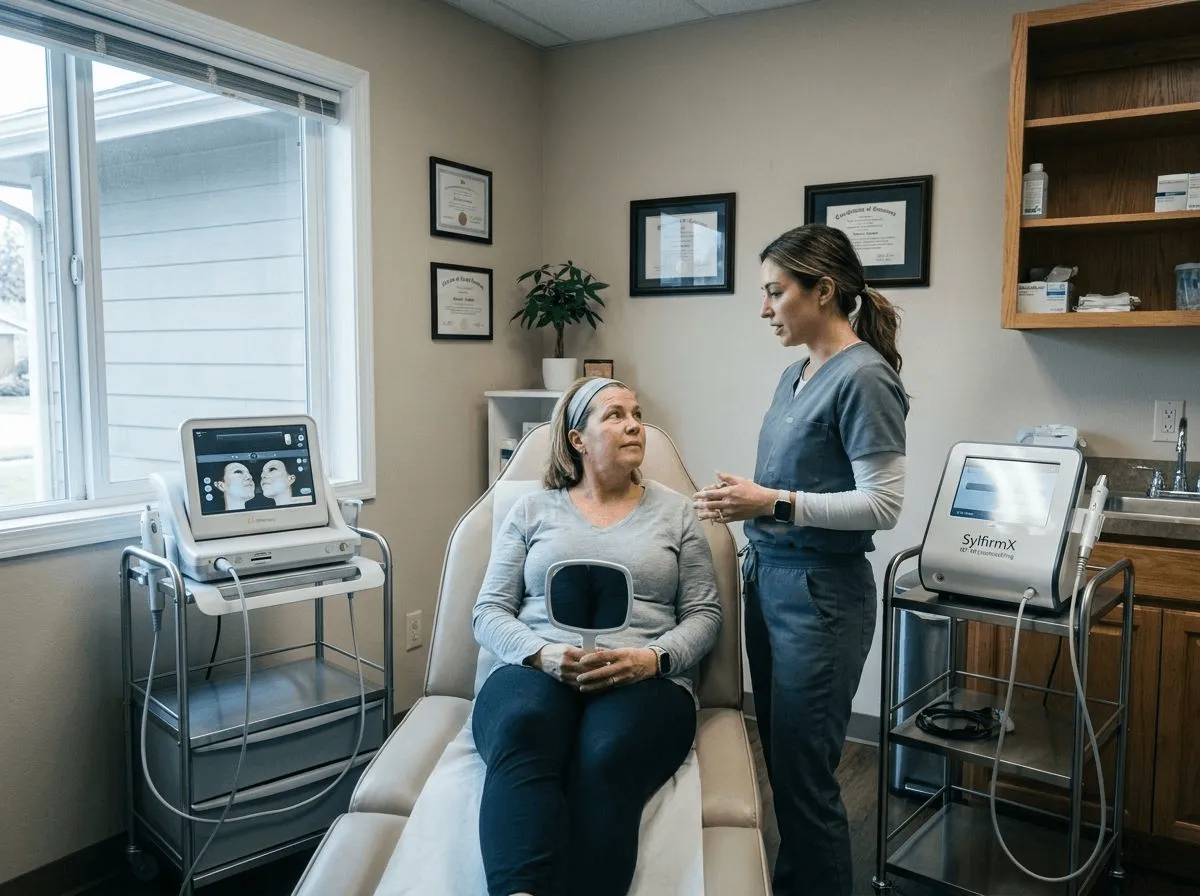
When skin begins to lose its firmness, patients often find themselves choosing between two of the most popular non-invasive tightening treatments available: Ultherapy and RF microneedling. Both stimulate collagen production. Both improve skin laxity without surgery. And both are offered by reputable clinics across the country. So how do you decide which one is right for your skin?
The answer lies in understanding what each technology does at the tissue level, because despite their shared goal of skin tightening, these treatments work through fundamentally different mechanisms, at different depths, and with different strengths. Choosing the wrong one for your specific concern may leave you with results that fall short of your expectations.
At Allen Medical Aesthetics, we offer both Ultherapy and RF microneedling with SylfirmX, so our recommendations are guided by your anatomy and goals rather than device availability. This guide provides a comprehensive comparison to help you make an informed decision.
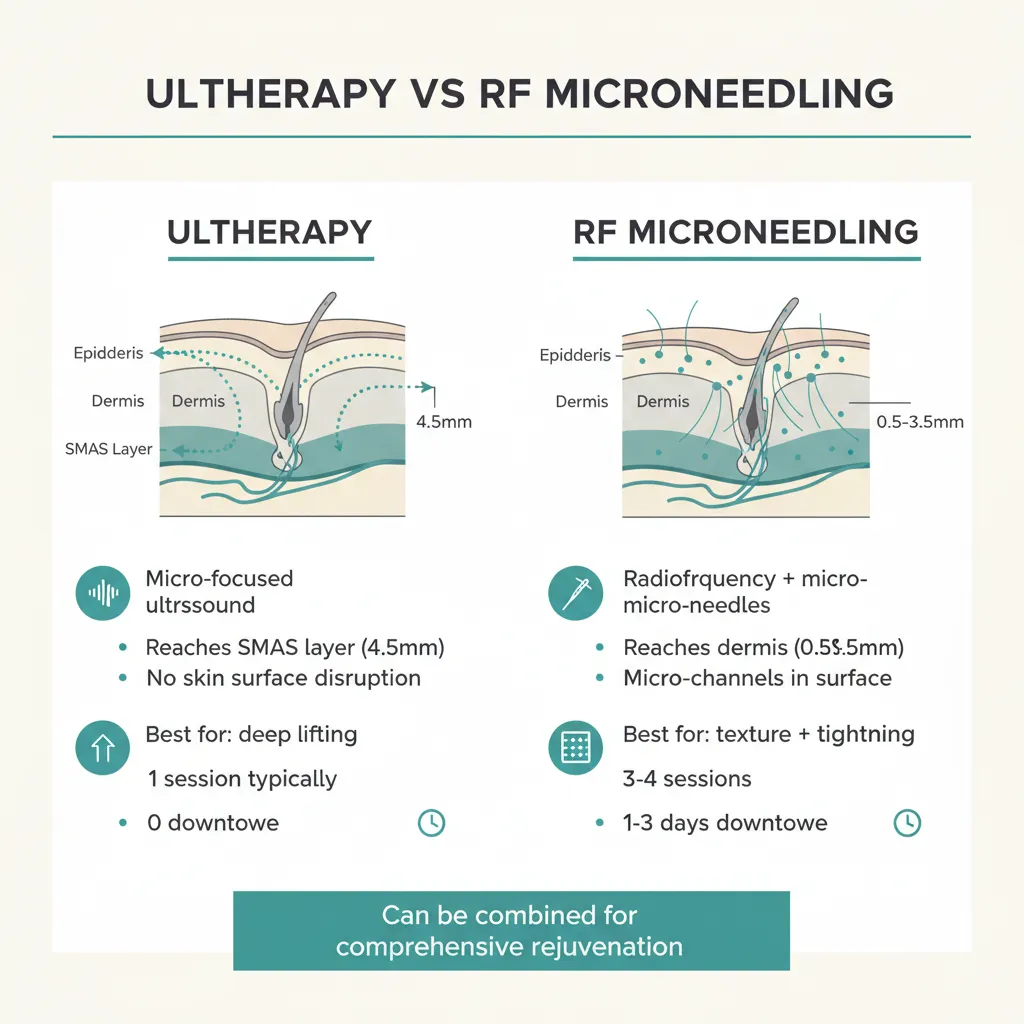
Ultherapy uses focused ultrasound energy (HIFU) to target the deep SMAS layer (3 to 4.5 mm) for lifting and structural tightening. RF microneedling delivers radiofrequency energy through tiny needles into the superficial to mid-dermis (0.5 to 4 mm) for collagen remodeling, texture improvement, and moderate tightening. Ultherapy excels at deep lifting; RF microneedling excels at surface-level remodeling and scar revision.
These treatments target different tissue depths and address different concerns. For deep structural lifting, Ultherapy is the stronger choice. For texture, scars, pores, and surface tightening, RF microneedling is typically more effective. Many patients benefit from combining both.
How Ultherapy Works: Focused Ultrasound Energy
Ultherapy delivers micro-focused ultrasound energy that converges at precise focal points beneath the skin. The focused energy raises tissue temperature to 60 to 70 degrees Celsius at specific depths, creating small thermal coagulation points that trigger a collagen remodeling response.
The defining feature of Ultherapy is its ability to reach the superficial muscular aponeurotic system (SMAS), a fibrous tissue layer located 3 to 4.5 millimeters below the skin surface. This is the same structural layer that surgeons tighten during a facelift. By targeting this deep layer with focused energy, Ultherapy can produce genuine tissue lifting and structural support that surface-level treatments cannot achieve.
The device includes ultrasound imaging that allows providers to visualize the tissue layers in real time, ensuring energy is delivered to the correct depth and tissue plane. This visualization capability adds a level of precision that is unique to the Ultherapy system.
Ultherapy is typically performed as a single treatment session, with results developing gradually over 2 to 6 months as new collagen forms and matures.
How RF Microneedling Works: Radiofrequency Plus Needles
RF microneedling combines two mechanisms: mechanical micro-injury from tiny needles penetrating the skin, and radiofrequency (RF) energy delivered through those needles into the surrounding tissue. The needles create controlled channels while the RF energy heats tissue at the needle tips, producing collagen denaturation and a robust wound healing response.
The treatment depth is adjustable from 0.5 to 4 millimeters, depending on the device and treatment area. Most RF microneedling treatments target the superficial to mid-dermis (1 to 3 mm), which is shallower than Ultherapy's SMAS-level targeting. This depth range is ideal for collagen remodeling within the dermis itself, where texture, scars, and pore structure reside.
At Allen Medical Aesthetics, we use the SylfirmX, a dual-wave RF microneedling device. The SylfirmX offers both continuous wave (CW) RF for collagen tightening and pulsed wave (PW) RF that selectively targets abnormal vasculature and pigmentation. This dual-wave capability makes it effective for conditions like melasma and rosacea that other RF microneedling devices may actually worsen.
RF microneedling is typically performed as a series of 3 to 4 treatments spaced 4 to 6 weeks apart, with cumulative improvement after each session.
The fundamental difference is depth and mechanism. Ultherapy focuses ultrasound energy at the deep SMAS layer for structural lifting. RF microneedling delivers RF energy through needles at the dermal level for surface and mid-tissue remodeling. They work at different layers and complement each other.
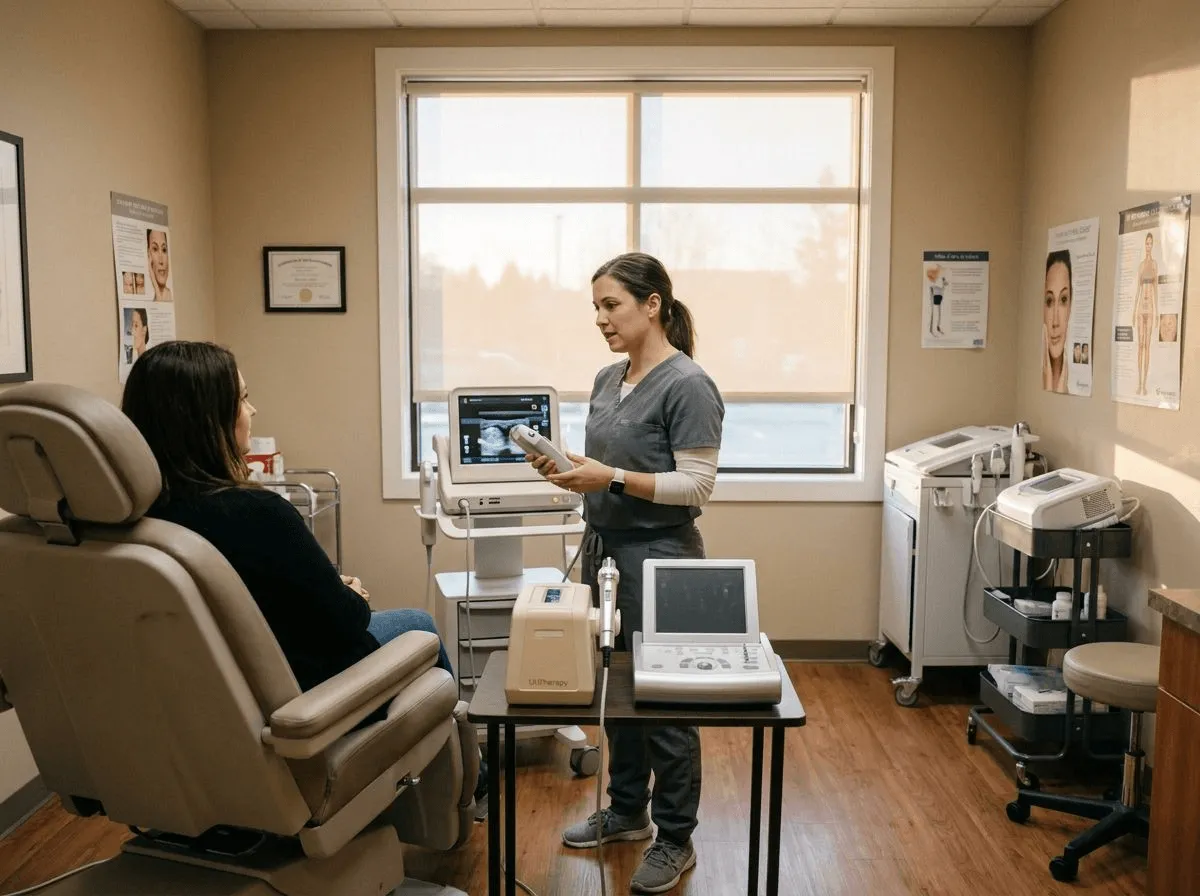
Head-to-Head Comparison
The following table provides a direct comparison across the factors that matter most when choosing between Ultherapy and RF microneedling.
| Factor | Ultherapy | RF Microneedling (SylfirmX) |
|---|---|---|
| Energy type | Micro-focused ultrasound (HIFU) | Radiofrequency + mechanical micro-needles |
| Treatment depth | 1.5 to 4.5 mm (targets SMAS) | 0.5 to 4.0 mm (targets dermis) |
| Primary strength | Deep tissue lifting and structural tightening | Texture, scars, pores, moderate tightening |
| Sessions needed | 1 session (maintenance annually) | 3 to 4 sessions, 4 to 6 weeks apart |
| Results timeline | 2 to 6 months (gradual) | 2 to 6 weeks per session, cumulative |
| Downtime | None to minimal (redness for hours) | 2 to 5 days (redness, mild swelling, pinpoint scabs) |
| Discomfort during treatment | Moderate to significant | Mild to moderate (with numbing) |
| Cost per session | $2,000 to $5,000 | $500 to $1,200 |
| Total series cost | $2,000 to $5,000 (single session) | $1,500 to $4,800 (3 to 4 sessions) |
| Safe for all skin tones | Yes | Yes |
Questions about skin rejuvenation?
Our providers offer consultations to discuss your options. The $50 fee is applied toward your first treatment.
Talk to a ProviderWhat Each Treatment Is Best For
The right choice depends on your primary concern. Here is a breakdown of which treatment delivers better results for common skin issues.
Deep Lifting and Structural Tightening
Ultherapy is the clear winner for deep tissue lifting. Its ability to target the SMAS layer allows it to produce genuine structural lifting that RF microneedling, which works at shallower depths, cannot match. For brow descent, jowling, and submental laxity where the primary issue is tissue that has dropped, Ultherapy is the better choice.
Skin Texture and Surface Quality
RF microneedling excels at surface-level and mid-dermal remodeling. The combination of mechanical micro-injury and RF energy produces dramatic improvements in skin texture, fine lines, pore size, and overall skin quality. Ultherapy, because it targets deeper layers, does not significantly address surface texture concerns.
Acne Scars and Scarring
RF microneedling is the preferred treatment for acne scars, surgical scars, and textural irregularities. The needles physically break up scar tissue while the RF energy remodels the collagen matrix around the scars. Ultherapy is not effective for scar revision because it works at a depth below where most scars reside.
Mild to Moderate Skin Laxity
Both treatments can address mild to moderate laxity, but through different mechanisms. Ultherapy provides more profound lifting from the deep tissue level. RF microneedling provides dermal tightening and contraction. For patients whose laxity is primarily a tissue descent issue (things have "dropped"), Ultherapy is stronger. For patients whose laxity is more about skin quality deterioration (crepiness, loss of firmness), RF microneedling may be more appropriate.
Neck Tightening
The neck presents a unique challenge because both tissue depth and surface quality matter. Ultherapy can tighten the deeper structural layers of the neck, while RF microneedling addresses the surface texture and fine horizontal lines. For neck concerns, a combination approach often produces the best overall outcome.
Recovery Comparison
Recovery is a practical consideration that influences treatment choice, especially for patients who cannot take significant time away from work or social commitments.
Ultherapy recovery: Most patients can return to normal activities immediately. Redness typically resolves within a few hours. Mild tenderness, tingling, or numbness in the treated area may persist for a few days to weeks in some cases. No visible wound healing occurs because the treatment does not break the skin surface. Makeup can be applied immediately after treatment.
RF microneedling recovery: Expect 2 to 5 days of visible downtime. Redness and mild swelling are common for the first 24 to 48 hours. Pinpoint scabs may form at the needle entry sites and resolve within 5 to 7 days. Makeup should be avoided for 24 hours. Sun protection is critical for at least 2 weeks. Active skincare ingredients (retinoids, acids) should be paused for 3 to 5 days.
The key difference is that Ultherapy recovery is essentially invisible (no broken skin surface), while RF microneedling involves visible healing during the first week. However, RF microneedling's downtime is short and manageable for most patients, especially when scheduled on a Thursday or Friday.
Cost Comparison
Cost comparisons between Ultherapy and RF microneedling require looking at total treatment investment rather than per-session price alone.
A single Ultherapy session for a full face treatment typically costs $2,000 to $5,000, depending on the treatment areas and the number of ultrasound lines delivered. This is a one-time cost, with optional annual maintenance sessions.
An RF microneedling series (3 to 4 sessions) totals approximately $1,500 to $4,800, depending on the device, treatment area, and provider. Maintenance sessions every 3 to 6 months are recommended to sustain results.
When you compare total first-year costs, the treatments end up in a similar range. However, the cost structure differs: Ultherapy is a larger single investment, while RF microneedling spreads the cost across multiple sessions. For ongoing maintenance over several years, RF microneedling may accumulate higher total costs because it requires more frequent sessions.
Both treatments represent a significantly lower investment than surgical alternatives like a facelift ($10,000 to $20,000+), making either option appealing for patients seeking non-invasive improvement.
When comparing costs, ask about the total treatment plan, not just the per-session price. Some clinics offer package pricing for RF microneedling series, which can reduce the per-session cost significantly.
Combining Ultherapy and RF Microneedling
Because Ultherapy and RF microneedling work at different tissue depths and address different concerns, combining them creates a comprehensive skin rejuvenation strategy that treats the full thickness of the skin.
A common combination approach starts with Ultherapy for deep structural lifting, then follows with a series of RF microneedling treatments to refine surface texture, tighten pores, and improve overall skin quality. This layered approach addresses aging at every level, from the SMAS up through the dermis and epidermis.
The treatments should be spaced appropriately. A typical sequencing protocol might look like this: Ultherapy first, followed by the first RF microneedling session 4 to 6 weeks later, then continuing with RF microneedling every 4 to 6 weeks for the full series. This allows the deep collagen remodeling from Ultherapy to progress while the RF microneedling addresses the surface layers.
This combination is particularly effective for patients with both structural laxity and surface texture concerns, which is common in patients over 40 who have experienced both tissue descent and cumulative skin quality deterioration.
For patients concerned about loose skin and texture, this combination may also be augmented with CO2 laser resurfacing for advanced surface renewal, creating a multi-technology treatment plan tailored to each patient's unique aging pattern.
How to Choose the Right Treatment
Selecting between Ultherapy and RF microneedling comes down to identifying your primary concern and matching it with the treatment that best addresses that concern.
Choose Ultherapy if: Your primary concern is tissue descent (brow drooping, early jowling, submental laxity). You want a single-session treatment. You prefer zero visible downtime. You are looking for deep structural improvement rather than surface texture changes.
Choose RF microneedling if: Your primary concerns are texture, scars, pores, fine lines, or surface-level skin quality. You are comfortable with multiple treatment sessions. You can accommodate a few days of visible recovery per session. You want to address both tightening and texture in one treatment.
Choose both if: You have concerns at multiple tissue levels (both structural laxity and surface quality). You want the most comprehensive non-surgical rejuvenation possible. You are investing in a long-term skin health strategy rather than a single correction.
At Allen Medical Aesthetics, we assess each patient's anatomy, skin quality, concerns, and goals before recommending a treatment plan. Because we offer both technologies, our recommendation is based entirely on what will produce the best outcome for you.

“When a patient comes to me wanting tighter skin, the first thing I assess is where the laxity lives. If the tissue has dropped and needs structural lifting, Ultherapy is my recommendation because it reaches the deep foundational layers. If the concern is more about surface texture, pores, or scarring, SylfirmX RF microneedling is the stronger choice. For many patients over 40, I recommend both because they address completely different layers of the skin.”
Linda Borge Jouini, MSN, RN Aesthetic Nurse Injector
Frequently Asked Questions
Can RF microneedling replace Ultherapy?
Not entirely. RF microneedling works at different tissue depths than Ultherapy and cannot reach the deep SMAS layer. For surface texture, scars, and mild to moderate tightening, RF microneedling is excellent. For deep structural lifting, Ultherapy remains the stronger non-invasive option.
Which hurts more, Ultherapy or RF microneedling?
Ultherapy is generally more uncomfortable during the procedure, particularly along the jawline and forehead. RF microneedling is performed with topical numbing cream and most patients tolerate it well. Both treatments are temporary in their discomfort.
Can I do Ultherapy and RF microneedling in the same session?
Performing both treatments on the same day is not typically recommended because each treatment triggers its own healing cascade. Spacing them 4 to 6 weeks apart allows each treatment's response to proceed optimally.
Which treatment has longer-lasting results?
Ultherapy results from a single session typically last 1 to 2 years. RF microneedling results from a full series can last 6 to 12 months. Both require maintenance treatments to sustain results over time.
Is one treatment safer than the other?
Both treatments have excellent safety profiles when performed by experienced providers. Ultherapy carries a small risk of temporary nerve sensitivity. RF microneedling carries a small risk of post-inflammatory hyperpigmentation in darker skin tones, though the SylfirmX's pulsed-wave mode reduces this risk significantly.
I have mild laxity and acne scars. Which should I choose?
For patients with both laxity and scarring, a combination approach is often ideal. RF microneedling addresses the scars more effectively, while Ultherapy provides the deeper lifting. Your provider can design a sequenced treatment plan that addresses both concerns.
Related Articles
This article supports our Ultherapy service page. Learn more about treatment options, candidacy, and what to expect.