

When patients come to us wanting to restore facial volume, smooth wrinkles, or improve skin quality, one of the first decisions we help them navigate is whether Sculptra or a traditional dermal filler is the right choice. Both are injectable treatments. Both can address volume loss and signs of aging. But they work in fundamentally different ways, produce different types of results, and serve different patient goals.
At Allen Medical Aesthetics in Des Moines, WA, we offer both hyaluronic acid dermal fillers and biostimulatory options like Sculptra. This guide provides a thorough, side-by-side comparison so you can walk into your consultation with a clear understanding of how each treatment works and which one aligns with your goals.
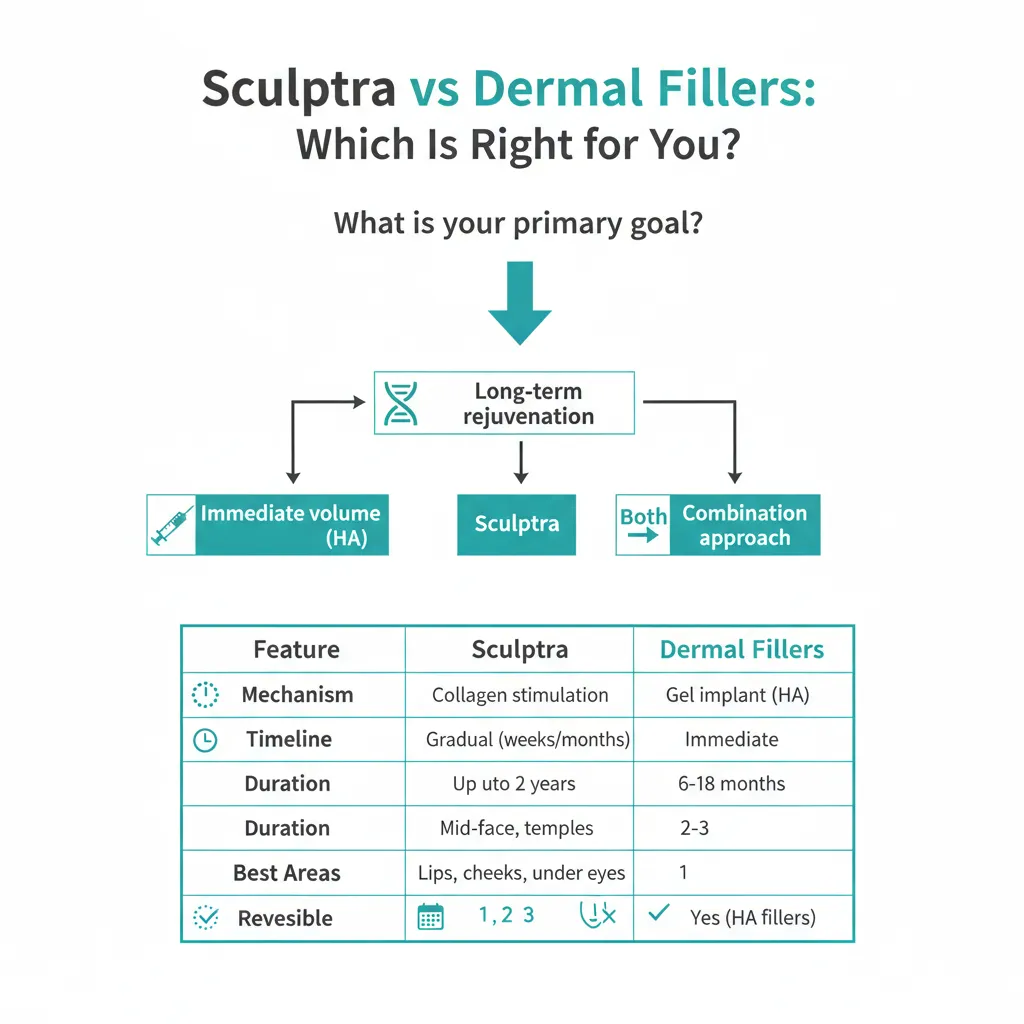
Sculptra stimulates your body to produce its own collagen over months, delivering gradual, natural-looking results that last 2+ years. Dermal fillers (hyaluronic acid) add immediate volume with a gel that lasts 6 to 18 months. Choose Sculptra for global volume restoration and long-term value. Choose dermal fillers for targeted augmentation, immediate results, or areas requiring precision like the lips.
These are not competing treatments. Many patients benefit from both, using Sculptra for structural foundation and dermal fillers for targeted refinement.
How Each Treatment Works: The Core Difference
The most important distinction between Sculptra and dermal fillers lies in their mechanism of action. Understanding this difference will clarify nearly every other comparison point.
Sculptra: Collagen Stimulation
Sculptra's active ingredient is poly-L-lactic acid (PLLA), a biocompatible synthetic polymer. When injected, the PLLA microparticles act as a scaffold that triggers your body's fibroblasts to produce new collagen. The PLLA itself is gradually metabolized and eliminated. The visible improvement you see is composed of collagen your own body built, not the injected material.
This means Sculptra results are inherently natural. The volume integrates with your existing tissue because it is your tissue. However, it also means the results take time. Collagen production builds over weeks to months, with peak results appearing 3 to 6 months after the final session in a series of 2 to 3 treatments.
Dermal Fillers: Volume Replacement
Hyaluronic acid (HA) fillers, such as Juvederm, Restylane, RHA, and Versa, work by physically occupying space beneath the skin. Hyaluronic acid is a naturally occurring sugar molecule that attracts and binds water, creating a hydrated gel that plumps the treated area instantly.
The result is immediate and visible as soon as the injection is complete (accounting for some initial swelling). The HA gel remains in place for months, gradually breaking down through natural enzymatic processes. Once fully metabolized, the volume is gone, and re-treatment is needed to maintain the correction.
HA fillers come in a range of formulations, from very thin gels designed for fine lines and lips to thicker, more structured products engineered for cheek augmentation and jawline contouring. This versatility is one of their greatest strengths.
Sculptra creates volume by stimulating your biology. Dermal fillers create volume by adding a physical gel. This fundamental difference drives every other comparison: timeline, longevity, treatment areas, reversibility, and candidacy.
Results Timeline: Gradual vs Immediate
The timeline for seeing results is one of the most significant practical differences between these two treatments, and it is often the deciding factor for patients.
With dermal fillers, results are visible immediately. You leave the office looking noticeably different from when you walked in. There may be some swelling that distorts the final result for 1 to 2 weeks, but the fundamental volume change is apparent on day one.
With Sculptra, the timeline is entirely different. You may see some initial fullness from the water carrier used to reconstitute the product, but this resolves within a few days. The real results develop over weeks as collagen production builds. After completing a full series of 2 to 3 sessions (spaced 4 to 6 weeks apart), peak results typically appear at the 3 to 6 month mark.
This means patients need to plan ahead when choosing Sculptra. If you have a wedding, reunion, or other event where you want to look your best, you should begin your Sculptra series at least 6 months in advance. For dermal fillers, 2 to 4 weeks of lead time is generally sufficient.
How Long Each Treatment Lasts
Longevity is where Sculptra holds a clear advantage. Sculptra results last an average of 25 months (approximately 2 years) after the final treatment session, with some patients maintaining visible improvement for up to 3 years. Because the results are made of your own collagen, they fade very gradually, much like natural aging.
Hyaluronic acid fillers have a shorter lifespan. Depending on the specific product and treatment area, HA fillers typically last 6 to 18 months. Thicker products used for structural support (cheeks, jawline) tend to last longer than thinner products used for lips or fine lines.
Over a multi-year timeframe, this longevity difference has meaningful implications. A patient maintaining cheek volume with HA fillers might visit the office 3 to 5 times over 5 years. A Sculptra patient might need the initial series (2 to 3 visits) plus 1 to 2 maintenance sessions over the same period.
| Treatment | Average Duration | Sessions Over 5 Years | Fade Pattern |
|---|---|---|---|
| Sculptra | 2 to 2.5 years | 3 to 5 total (initial + maintenance) | Very gradual, natural |
| Juvederm Voluma (cheeks) | 12 to 24 months | 3 to 5 sessions | Moderate, then noticeable |
| Restylane Lyft (cheeks) | 12 to 18 months | 3 to 5 sessions | Moderate |
| Juvederm Ultra (lips) | 6 to 12 months | 5 to 10 sessions | Moderate to quick |
| RHA Collection | 12 to 18 months | 3 to 5 sessions | Moderate |
Questions about injectables?
Our providers offer consultations to discuss your options. The $50 fee is applied toward your first treatment.
Talk to a ProviderTreatment Areas: Where Each Excels
Not every area of the face responds equally well to both treatments. Understanding where each product excels helps guide treatment decisions.
Sculptra is ideal for broad areas of diffuse volume loss. It works exceptionally well in the temples, midface, cheeks, pre-jowl sulcus, and along the jawline, all areas where age-related volume loss creates a deflated or hollowed appearance. Sculptra is also used off-label in the body (buttocks augmentation) and for improving overall skin thickness and quality across larger facial zones.
Dermal fillers are the superior choice for areas requiring precision and immediate definition. The lips, nasolabial folds, marionette lines, under-eye hollows (tear troughs), chin augmentation, and fine perioral lines all respond better to HA fillers. These areas benefit from the ability to sculpt and mold the filler in real time, creating precise contours that Sculptra's gradual mechanism cannot replicate.
- Sculptra-preferred areas: Temples, midface, cheeks (broad volumization), pre-jowl sulcus, jawline (global definition), areas of diffuse skin laxity
- Filler-preferred areas: Lips, tear troughs, nasolabial folds (precise correction), marionette lines, chin (targeted projection), fine lines around the mouth
- Either/both: Cheeks (Sculptra for foundation, filler for highlight), jawline (Sculptra for volume, filler for contouring)
Sculptra should never be injected into the lips or the periorbital area (around the eyes). These areas lack sufficient tissue depth, and the collagen stimulation response can produce visible or palpable nodules. Hyaluronic acid fillers remain the standard of care for lip augmentation and tear trough correction.
Reversibility: A Critical Safety Consideration
One factor that many patients overlook when choosing between treatments is reversibility. This is an important safety consideration, especially for first-time injectable patients.
Hyaluronic acid fillers are fully reversible. An enzyme called hyaluronidase can dissolve HA filler within hours if the results are unsatisfactory, if the filler migrates to an unintended area, or if a rare vascular complication occurs. This safety net is one of the primary reasons HA fillers remain the most widely used injectable in the world.
Sculptra is not reversible. Once injected, the PLLA cannot be dissolved or removed. More importantly, the collagen your body produces in response to Sculptra is permanent tissue, even though it will naturally turn over and diminish over 2 to 3 years. If the results are not to your liking, you must wait for the natural collagen remodeling process to run its course.
This is not a reason to avoid Sculptra, but it does underscore the importance of choosing an experienced provider who understands facial anatomy and has significant experience with biostimulatory products. At Allen Medical Aesthetics, we take a conservative, build-over-time approach with Sculptra, adding volume gradually across multiple sessions rather than over-correcting in a single appointment.
Cost Comparison: Per Session vs Long-Term Value
The cost comparison between Sculptra and dermal fillers depends on whether you are looking at per-session cost or long-term value over multiple years.
On a per-session basis, Sculptra treatments tend to be comparable to or slightly higher than dermal filler appointments. A typical Sculptra session involves 2 to 4 vials, and the full treatment series (2 to 3 sessions) requires a meaningful upfront investment. A single dermal filler appointment may cost less, particularly if only 1 to 2 syringes are used.
However, the long-term math often favors Sculptra. Because results last 2+ years compared to 6 to 18 months for most HA fillers, the annual cost of maintaining your results with Sculptra is frequently lower. Patients who have been maintaining their appearance with HA fillers for several years and are looking for a more cost-effective long-term solution often find Sculptra to be a smart transition.
During your consultation at Allen Medical Aesthetics, your provider will outline the expected treatment plan for both options, including the estimated number of sessions, product quantities, and projected timeline. This allows you to compare the total investment for each approach based on your specific needs.
Ask your provider to map out the total cost over a 2 to 3 year period for both options. Comparing single-session prices can be misleading because the number of maintenance visits differs significantly.
When to Choose Sculptra
Sculptra is the better choice in several specific scenarios. Consider Sculptra if any of the following describe your situation.
- You have broad, diffuse volume loss across the temples, midface, or lower face
- You prefer a gradual transformation that does not look "done" at any point
- You want results that last 2+ years without frequent maintenance visits
- You are tired of the cycle of HA filler treatments every 6 to 12 months
- You are looking for improved skin quality and thickness in addition to volume
- You have mild to moderate skin laxity and want a non-surgical option to address it
- You are planning ahead and do not need results for an upcoming event in the near term
- You are comfortable committing to a multi-session treatment series

“I recommend Sculptra when a patient has lost volume across broad areas of the face, particularly the temples, cheeks, and midface. If someone comes in wanting fuller lips or a precise correction in the nasolabial folds, that is where hyaluronic acid fillers are the better tool. For many of my patients, the best plan combines both: Sculptra to rebuild the structural foundation and HA fillers for the finishing details.”
Anna Yi, MSN, ARNP Aesthetic & Functional Wellness Nurse Practitioner
When to Choose Dermal Fillers
Dermal fillers are the better choice in a different set of circumstances. Consider HA fillers if any of the following apply.
- You want immediate, visible results from a single appointment
- You are treating areas that require precision (lips, tear troughs, nasolabial folds)
- You are a first-time injectable patient who values the reversibility safety net
- You have an upcoming event and need results within 2 to 4 weeks
- You prefer to invest incrementally rather than committing to a multi-session series upfront
- You are addressing specific lines or folds rather than broad volume loss
- You want to try a small, targeted enhancement before considering a more comprehensive plan
When to Combine Both Treatments
In our practice, many of the best outcomes come from combining Sculptra with dermal fillers rather than choosing one over the other. The two products complement each other because they address different aspects of facial aging.
A common combination approach uses Sculptra to rebuild the foundational volume in the midface, temples, and jawline, which is the deep structural volume that gives the face its youthful shape. Once that foundation is established (typically after the Sculptra series is complete and collagen production has peaked), dermal fillers are used for targeted refinements: enhancing the lips, smoothing the nasolabial folds, correcting tear trough hollowing, or adding precise definition to the chin.
EZ Gel PRF is another option that pairs well with both Sculptra and traditional fillers. As a natural biofiller derived from your own blood, EZ Gel PRF provides immediate volume along with growth factor-driven collagen stimulation. Some patients use EZ Gel as a bridge between their Sculptra sessions or as an alternative in areas where they prefer a fully natural product.
Your provider will sequence these treatments with appropriate intervals between them, typically waiting 2 to 4 weeks between different injectable types. The combination approach costs more upfront than either treatment alone but often delivers the most comprehensive and longest-lasting results.
Think of Sculptra as the foundation and dermal fillers as the finish work. Sculptra rebuilds the structural volume that underpins a youthful facial shape. Dermal fillers add the precise details and refinements. Together, they address facial aging more completely than either treatment alone.
Candidacy: Who Should Avoid Each Treatment
Both treatments are safe for the vast majority of adult patients, but there are some contraindications and considerations for each.
Sculptra should be avoided by patients with active autoimmune conditions, active skin infections in the treatment area, a history of hypertrophic scarring or keloid formation, or those who are pregnant or breastfeeding. Patients with a history of granuloma formation with other injectable products should discuss this with their provider before proceeding.
Dermal fillers share many of the same contraindications (active infection, pregnancy, breastfeeding). Additionally, patients with a known allergy to hyaluronic acid or any filler component should avoid HA-based products. Patients with a history of vascular occlusion from previous filler treatments should seek an experienced injector who understands facial vascular anatomy in detail.
During your consultation at Allen Medical Aesthetics, your provider will review your complete medical history, current medications, and aesthetic goals to determine which treatment (or combination) is safest and most effective for you.
Frequently Asked Questions
Is Sculptra better than filler?
Neither is universally "better." They serve different purposes. Sculptra is better for global volume restoration, long-term value, and natural-looking gradual improvement. Dermal fillers are better for immediate results, precise contouring (lips, tear troughs), and reversibility. Many patients benefit from both.
Can I switch from dermal fillers to Sculptra?
Yes. Many patients who have been maintaining their appearance with HA fillers for years transition to Sculptra for longer-lasting results. Your existing HA filler does not need to be dissolved before starting Sculptra, as the two products can coexist in the same facial areas.
Does Sculptra look natural?
Sculptra is widely considered one of the most natural-looking injectable treatments available. Because the volume is composed of your own collagen rather than an external gel, the results integrate seamlessly with your facial tissues. The gradual timeline also means there is never a sudden, obvious change.
Why can Sculptra not be used in the lips?
The lip tissue is thin and highly mobile, which increases the risk of nodule formation when Sculptra is injected. The collagen stimulation response can produce visible or palpable lumps in areas without sufficient tissue depth. Hyaluronic acid fillers remain the standard for lip augmentation because they are soft, moldable, and reversible.
How do I know which treatment I need?
The best way to determine which treatment is right for you is a consultation with an experienced injector who offers both options. Your provider will assess your facial anatomy, volume loss patterns, skin quality, and aesthetic goals, then recommend the approach (or combination) that best matches your needs and timeline.
Can I get Sculptra and filler on the same day?
In some cases, yes. However, most providers prefer to space the treatments 2 to 4 weeks apart to minimize swelling and allow each product to settle properly. Your provider will advise on the optimal scheduling based on your treatment plan.
Related Articles
This article supports our Biostimulatory Fillers service page. Learn more about treatment options, candidacy, and what to expect.