
IPL (intense pulsed light) photofacial is one of the most popular treatments for improving skin tone, reducing sun damage, and clearing redness. Unlike ablative lasers, IPL works beneath the surface without removing skin, which means minimal downtime and gradual, natural-looking improvement over a series of sessions.
But what do IPL results actually look like? How much improvement can you expect after one treatment versus a full series? At Allen Medical Aesthetics in Des Moines, WA, we use IPL photofacial to address sun spots, redness, broken capillaries, rosacea, and uneven skin tone. This guide covers the realistic results you can expect, what happens at each session, and how to determine whether IPL is the right treatment for your skin.
IPL photofacial produces gradual improvement in sun spots, redness, and uneven skin tone over a series of 3 to 5 treatments spaced 3 to 4 weeks apart. Changes become visible within 7 to 14 days of each session as treated pigment darkens, flakes off, and reveals clearer skin underneath.
IPL delivers cumulative results. Each session builds on the last, so patience and consistency are essential for optimal outcomes. Plan for 3 to 5 treatments spaced 3 to 4 weeks apart.
How IPL Photofacial Works
IPL (intense pulsed light) uses broad-spectrum light to target chromophores in the skin, specifically melanin (brown pigment) and hemoglobin (red pigment in blood vessels). When these targets absorb the light energy, they heat up and break apart. The body then naturally clears the fragmented pigment and damaged vessels over the following days and weeks.
Unlike a laser, which emits a single wavelength of light, IPL delivers a range of wavelengths (typically 500 to 1,200 nm). This versatility allows the provider to address multiple concerns in a single session. By adjusting the filters, pulse duration, and energy levels, we can prioritize brown pigment, red pigment, or both during your treatment.
IPL is a non-ablative treatment, meaning it does not remove or damage the outer layer of skin. The light passes through the epidermis and targets structures beneath the surface. This is why IPL has significantly less downtime than ablative treatments like CO2 laser resurfacing. Most patients return to normal activities the same day or the next day.
Typical IPL Results by Concern
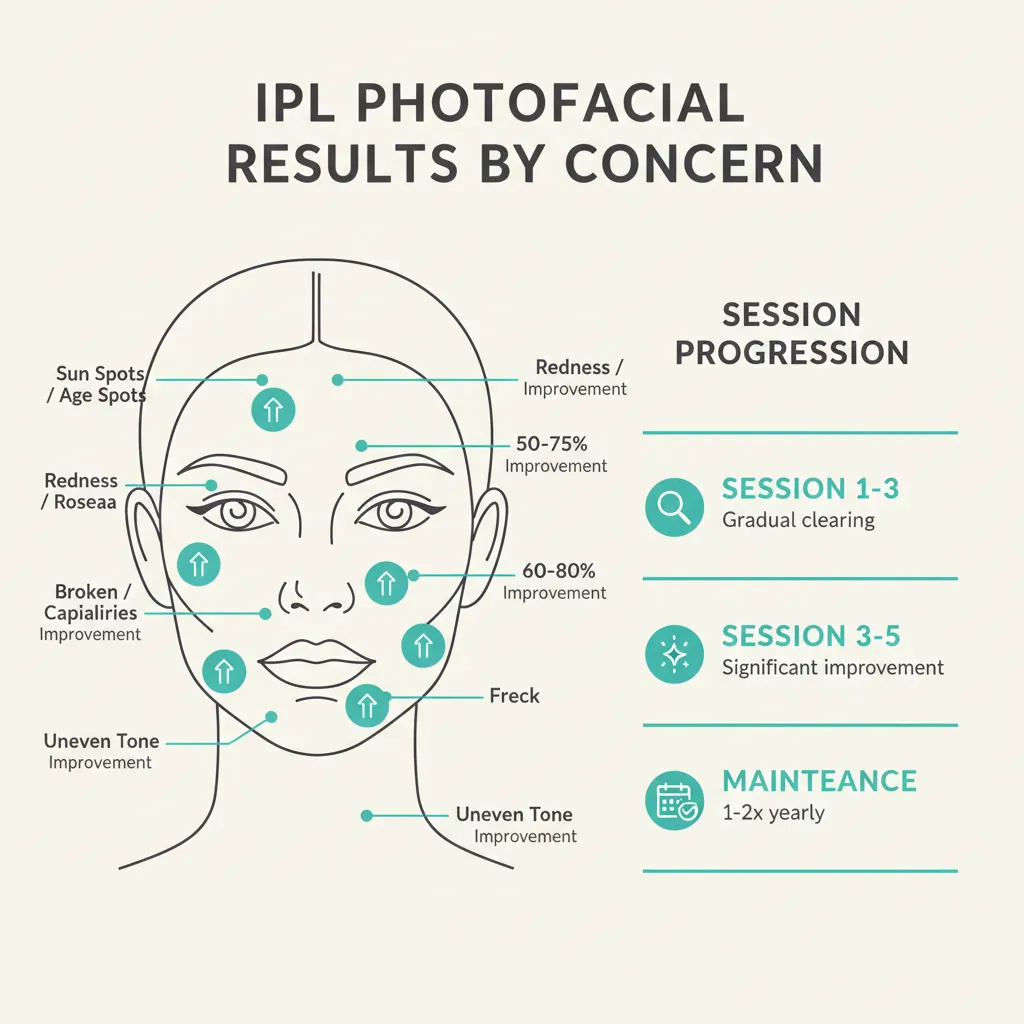
IPL photofacial addresses several different skin concerns, but the degree of change varies depending on what you are treating and your individual skin. The table below reflects what to generally expect after a complete treatment series (3 to 5 sessions), and your provider will set expectations specific to your skin at consultation.
| Concern | What to Expect After Full Series | Sessions Needed | Response Notes |
|---|---|---|---|
| Sun Spots / Age Spots | Significant clearing | 3 to 5 | Spots darken within 24 to 48 hours, then flake off over 7 to 14 days. Superficial spots respond fastest. |
| Freckles (Lentigines) | Marked clearing | 2 to 4 | Freckles are typically superficial and respond very well. Some may return with sun exposure. |
| Diffuse Redness / Flushing | Moderate improvement | 3 to 5 | Improvement is gradual. Redness associated with rosacea may require ongoing maintenance. |
| Broken Capillaries (Telangiectasia) | Significant clearing | 2 to 4 | Small, fine vessels respond best. Larger or deeper vessels may need vascular laser treatment. |
| Rosacea Redness | Moderate improvement | 3 to 6 | IPL is effective for redness and visible vessels. Does not treat papules or pustules directly. |
| Uneven Skin Tone | Noticeably more even tone | 3 to 5 | Overall tone becomes more uniform. Combines well with chemical peels for enhanced results. |
| Melasma | Mild improvement, variable | Variable | IPL is not first-line for melasma. Low-energy settings may help, but risk of worsening exists. |
IPL is highly effective for sun-induced pigmentation and vascular concerns. However, it is not the best choice for melasma, which is hormonally driven and can worsen with light-based treatments. If you have melasma, a consultation is essential to determine the safest approach for your skin.
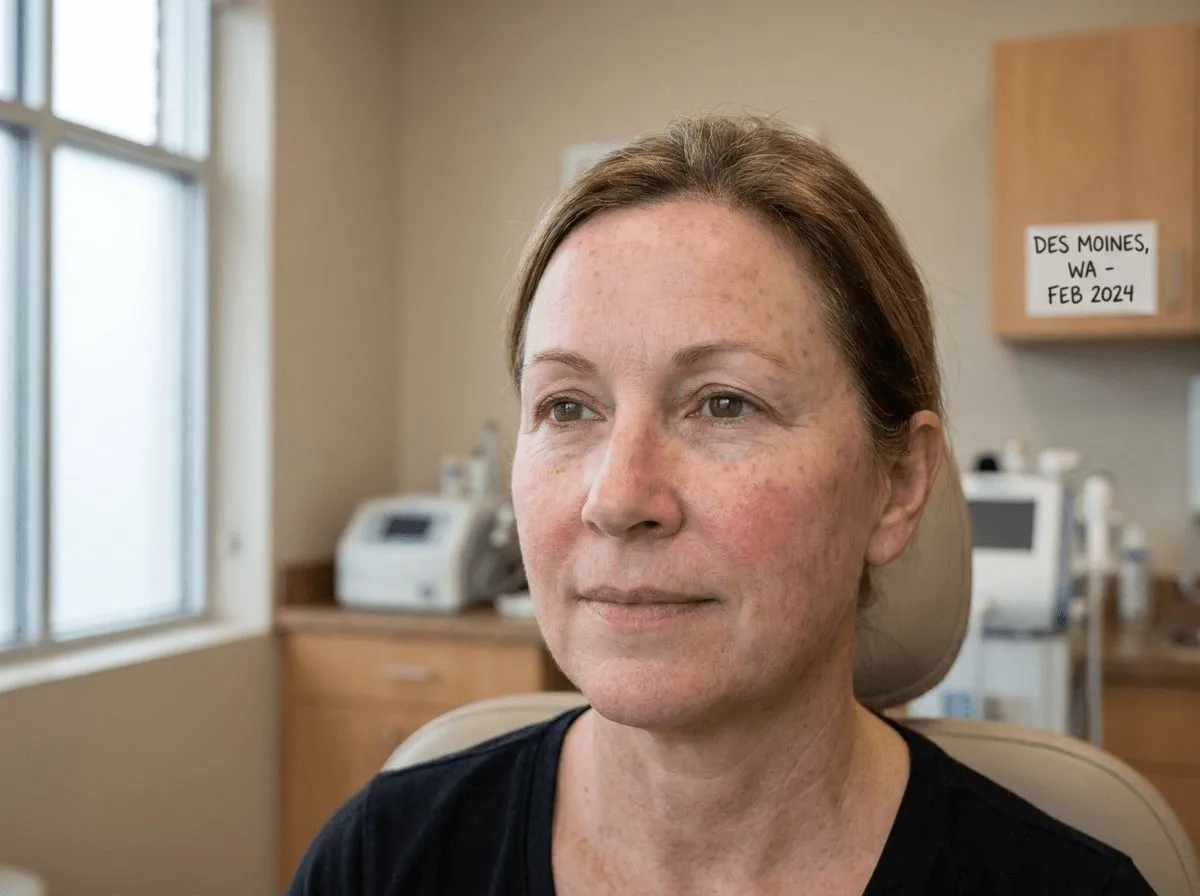

“Most of my IPL patients start seeing a real difference after the second session. The sun spots darken and flake off, and each time they come back, their skin looks noticeably more even. By the end of a full series, the transformation is something patients can truly see and feel.”
Morgan Selland, LME, LSO, MA Clinic Manager & Laser Safety Officer
Session-by-Session: What Improvement Looks Like
One of the most common questions patients ask is how much improvement they will see after each individual session. IPL results are cumulative, meaning each treatment builds on the progress from the last. Here is what a typical progression looks like for a patient treating sun damage and mild redness.
After Session 1
The first treatment primarily targets the most superficial and visible pigmentation. Within 24 to 48 hours after treatment, sun spots and freckles will darken noticeably. This is a good sign. It means the pigment has absorbed the light energy and is being brought to the surface. Over the next 7 to 14 days, these darkened spots will crust lightly and flake off, revealing lighter skin underneath.
After the first session, expect a modest improvement in brown spots and a subtle reduction in overall redness. The skin may look slightly more even in tone, but there is still plenty of residual pigment and vascular activity to address.
After Session 2
The second treatment, performed 3 to 4 weeks after the first, targets the next layer of pigment and begins to make a more noticeable impact on redness and broken capillaries. Patients often report that the darkening response is less dramatic at this session because the most superficial pigment was already cleared.
Cumulative improvement builds noticeably by session 2. Friends and family may start to notice that your skin looks clearer and brighter.
After Sessions 3 and 4
Sessions 3 and 4 address deeper pigmentation and more stubborn vascular concerns. The provider may increase energy settings slightly as your skin has shown its response pattern. These sessions are often when patients see the most satisfying jump in results.
By the end of session 4, cumulative improvement is substantial for most patients. The skin tone is noticeably more uniform, redness is significantly reduced, and broken capillaries have cleared or faded substantially.
After Session 5 (If Needed)
A fifth session may be recommended for patients with extensive sun damage, persistent redness, or deeper pigmentation. After a complete series, most patients see a significant improvement in their primary concern. The skin appears clearer, more even, and healthier overall.
Take a photo in the same lighting on the same day of each session. IPL improvement is gradual, and having consistent comparison photos makes it much easier to appreciate the cumulative progress.
Questions about laser and skin?
Our providers offer consultations to discuss your options. The $50 fee is applied toward your first treatment.
Talk to a ProviderRecovery Timeline After Each IPL Session
One of the biggest advantages of IPL photofacial is the minimal recovery time. Unlike ablative treatments, IPL does not remove the outer layer of skin, so healing is straightforward and downtime is limited.
| Timeframe | What to Expect |
|---|---|
| Immediately After | Mild redness and warmth, similar to a light sunburn. This typically resolves within 2 to 4 hours. Some patients experience slight swelling around the eyes or cheeks. |
| Day 1 to 2 | Treated pigment spots darken and become more visible. This is normal and expected. The skin may feel slightly tight or dry. |
| Days 3 to 7 | Darkened spots begin to crust or flake. The pigment sheds naturally. Avoid picking or scrubbing the treated areas. Makeup can be applied as usual. |
| Days 7 to 14 | Most darkened pigment has flaked off, revealing clearer, more even skin underneath. Redness reduction becomes noticeable. |
| Weeks 2 to 4 | Full results from the session are visible. Skin continues to improve as residual inflammation resolves. Ready for the next treatment session. |
How Many IPL Sessions Do You Need?
The number of IPL sessions you need depends on the severity of your concerns, your skin type, and your treatment goals. Most patients require 3 to 5 sessions spaced 3 to 4 weeks apart for optimal results.
Patients with mild sun damage (a few scattered sun spots and minimal redness) may see satisfying results after 2 to 3 sessions. Those with moderate to extensive sun damage, widespread redness, or numerous broken capillaries typically need 4 to 5 sessions. Rosacea patients may need 4 to 6 sessions initially, followed by maintenance treatments every 6 to 12 months.
After completing your initial treatment series, maintenance sessions are recommended once or twice per year to preserve your results. Sun exposure and natural aging will gradually introduce new pigmentation and vascular changes, so periodic touch-ups help maintain the improvement you have achieved.
Who Is a Good Candidate for IPL Photofacial
IPL photofacial works best on patients with fair to medium skin tones (Fitzpatrick types I through III). This is because the light energy targets the contrast between the pigmented lesion and the surrounding skin. Greater contrast means more selective treatment with less risk of unwanted side effects.
Ideal candidates include patients with sun spots, age spots, or freckling from UV exposure, those with diffuse facial redness, flushing, or visible broken capillaries, patients with mild to moderate rosacea (erythematotelangiectatic subtype), and anyone looking to improve overall skin tone and clarity without significant downtime.
Who Should Avoid or Use Caution with IPL
Patients with darker skin tones (Fitzpatrick types IV through VI) face a higher risk of burns, hyperpigmentation, or hypopigmentation from IPL treatment. The broad-spectrum light can be absorbed by melanin in the surrounding skin rather than just the targeted lesion. For these patients, alternative treatments such as chemical peels or specific wavelength lasers may be safer options.
IPL is not appropriate for patients who are pregnant or breastfeeding, those who have used isotretinoin (Accutane) in the past 6 months, patients with active skin infections or open wounds in the treatment area, or anyone with a recent tan (natural or spray). Tanned skin absorbs the light energy indiscriminately and significantly increases the risk of burns.
Sun exposure and tanning are the biggest risk factors for IPL complications. Avoid sun exposure for at least 2 to 4 weeks before and after each treatment. If you have a tan, your provider should postpone treatment until it fades completely.
IPL Photofacial vs Other Treatments
Patients often want to know how IPL compares to other treatments that address similar concerns. Here is a brief comparison to help you understand where IPL fits in the spectrum of skin rejuvenation options.
| Feature | IPL Photofacial | CO2 Laser | Chemical Peels |
|---|---|---|---|
| Best For | Sun spots, redness, broken capillaries | Deep wrinkles, acne scars, significant sun damage | Fine lines, superficial pigment, dullness |
| Downtime | None to minimal (return to activities same day) | 7 to 14 days of visible healing | 1 to 7 days depending on peel depth |
| Sessions Needed | 3 to 5 for optimal results | 1 to 2 for most concerns | 3 to 6 depending on depth |
| Discomfort | Mild (snapping sensation) | Moderate to significant (numbing required) | Mild to moderate (stinging, burning) |
| Skin Type Suitability | Types I to III | Types I to III | Types I to V (depending on peel type) |
IPL and chemical peels can be excellent complements. Many patients alternate between the two, using IPL to target pigment and vascular concerns while using peels to refine texture and promote cell turnover.
Maximizing and Maintaining Your IPL Results
The results of IPL photofacial are durable, but they are not permanent. Your skin will continue to be exposed to UV light, hormonal changes, and the natural aging process. Taking the right steps before and after treatment can significantly impact the quality and longevity of your results.
Before each session, avoid sun exposure and tanning for 2 to 4 weeks, discontinue retinoids and exfoliating acids 3 to 5 days before treatment, avoid aspirin, ibuprofen, and blood-thinning supplements for 1 week before treatment (these can increase bruising risk), and arrive with clean skin free of makeup and sunscreen.
After each session, apply a gentle moisturizer and broad-spectrum mineral sunscreen (SPF 30 or higher) daily, avoid direct sun exposure for at least 2 weeks, allow darkened spots to flake off naturally without picking or scrubbing, and avoid saunas, hot tubs, and intense exercise for 24 to 48 hours.
For long-term maintenance, wear sunscreen daily (this is the single most impactful habit for preserving IPL results), schedule maintenance treatments once or twice per year, use medical-grade skincare products with antioxidants (such as vitamin C serum) and retinoids, and consider complementary treatments like chemical peels between IPL sessions to maintain skin clarity.
Frequently Asked Questions
Does IPL photofacial hurt?
Most patients describe IPL as a series of quick snapping sensations, similar to a rubber band flicking against the skin. The discomfort is mild and brief. No numbing cream is required for most patients, though it can be applied for sensitive areas. Treatments typically take 20 to 30 minutes.
How long do IPL results last?
IPL results are long-lasting but not permanent. With proper sun protection and skincare, results from a full treatment series can last 1 to 2 years before maintenance is needed. New sun spots and redness will develop over time with continued UV exposure, which is why annual maintenance sessions are recommended.
Can I wear makeup after IPL?
Yes, you can apply makeup immediately after IPL treatment or the following day. There is no open wound or peeling skin that would prevent makeup application. Use mineral-based makeup for the first few days if the treated area feels sensitive.
Is IPL the same as laser treatment?
No. IPL uses broad-spectrum light (multiple wavelengths), while a laser uses a single, focused wavelength. IPL is versatile and can treat both pigment and vascular concerns in one session. Lasers tend to be more targeted and may be more effective for specific, deep concerns. Both have their advantages depending on the condition being treated.
Can IPL treat melasma?
IPL is generally not recommended as a first-line treatment for melasma. Because melasma is hormonally driven and resides deeper in the skin, IPL can sometimes worsen it by triggering additional melanin production. Chemical peels, topical treatments, and certain laser protocols are typically preferred for melasma management.
What happens if I get sun exposure between IPL sessions?
Sun exposure between sessions increases the risk of burns, uneven results, and post-inflammatory hyperpigmentation. If you develop a tan between sessions, your provider should postpone the next treatment until the tan fades. Consistent sun protection is essential throughout your IPL treatment series.
How soon after IPL can I exercise?
Avoid intense exercise, saunas, and hot tubs for 24 to 48 hours after each IPL session. Heat and sweating can increase redness and inflammation in the treated area. Light walking and normal daily activities are fine immediately after treatment.
Related Articles
This article supports our Ipl Photofacial service page. Learn more about treatment options, candidacy, and what to expect.